


Storytelling is emotionally powerful. Hollywood learned long ago that creating compelling characters and working certain storytelling gimmicks through them could get their viewers rooting for villains and booing heroes. Those who are monsters in real life are made sympathetic in our favorite shows and those who are the very sustenance of thriving community are cast there as villains to be despised. A rude remark demands death for one character while no level of personal evil by another makes the slightest dent in their popularity by addicted viewers.
Dexter, for instance, had audiences rooting for a serial killer and hoping for his victory over the police officer who was pursuing him. Some were even relieved when that officer was finally killed so Dexter could continue his own crusade without interference. He wasn’t like those other nasty serial killers… Dexter was cool.
Revolving-Door Morality
In this vein, I’ve noticed another trend… a revolving door of good and evil and amnesia in many of the most popular television characters in the last couple decades. Yesterday’s murderer is today’s hero. Yesterday’s hero is tomorrow’s monster. And somehow, by next Thursday, everybody is friends again. They project evil without lasting guilt, redemption without lasting transformation, and trust without evidence of trustworthiness. Characters have no dependable character.
This is a type of madness that infects much of modern television drama. A character commits an act of breathtaking evil—murder, betrayal, torture, perhaps the calculated destruction of many innocent lives. The other characters respond with appropriate horror. Friendships are shattered, loyalties broken, and righteous indignation fills the screen. We, the audience, are expected to share that outrage… and we do.
Then something remarkable happens. The villain sheds a tear, offers an excuse, reveals a painful childhood, or performs one conveniently timed heroic deed. Suddenly, forgiveness flows like water. Former enemies embrace. The perpetrator is welcomed back into the fellowship of the righteous, entrusted with precious responsibilities, and is sometimes restored to a position of moral authority. Then, a few episodes later, the same character commits another atrocity. The cycle begins anew. Nobody learns a lesson.
And we, the audience, are expected to celebrate… to forget… and we do. “Why that’s like soooo last episode, Dude!”
Meanwhile, another previously admirable character undergoes an inexplicable personality transformation and becomes the new villain. And once again, we are expected to be outraged… disappointed… and we are.
All that Glitters is not Gold
In this pattern, the writers have discovered an apparently inexhaustible dramatic resource, keeping the audience in an eternal and wholly emotional present dictated by the alchemy of cinematic choreography.
And it is this audience reaction that proves the most disturbing element of this peculiar arrangement. The audience is expected to experience outrage and forgiveness without memory… and we do. We are invited to feel deeply about everything while thinking reasonably and consistently about almost nothing… and we do.
The Why and What of It All
Is this simply bad writing? An inexpensive method of manufacturing conflict in an industry perpetually hungry for the next dramatic confrontation? Or might something more consequential be taking place, whether by design or by accident?
And what happens to our moral sensibilities in the rest of life when we repeatedly submit ourselves to this entertaining emotional merry-go-round by riding it again and again without realizing what is being done to us? Would you work hand in hand on Wednesday with the man who ruthlessly murdered your sister on Monday and apologized on Tuesday with some lame excuse for why he did it? Would you forget?
Unlikely, but we do this again and again and again when watching shows like Heroes, Under the Dome, and iZombie… and many many more of late.
These series differ considerably in premise, style, and execution, yet each provides opportunities to examine the shifting moral status of recurring characters.
Big Jim Under the Dome
In Under the Dome, Big Jim Rennie (A consistently deceitful villain in the book) repeatedly moves between public leadership, ruthless self-preservation, manipulation, vengeance, violence, cold blooded murder, and cooperation with those he has endangered. He is not simply an evil man occasionally doing something useful. His position within the story continually raises questions about how much previous conduct other characters (and the audience with them) are expected to overlook.
Blaine Sometime-Zombie Debeers
In iZombie, Blaine DeBeers is a particularly intriguing example. Charming, dangerous, self-interested, and occasionally useful, Blaine moves through relationships in which practical cooperation coexists with a history of appalling wrongdoing. His charisma complicates the audience’s judgment, while his usefulness complicates the protagonists’ decisions. The violence of justice is equated with the violence of deepest evil by the story writers and this confusion continually restrains the hands of the righteous whose failure to exact justice when that power is in their hands proves an enablement of ongoing evil… but no matter, nobody remembers, and nobody learns any lessons.
Sylar the Well Meaning Serial Killer
In Heroes, Sylar begins as a terrifying serial killer whose appetite for power makes him one of the show’s principal threats. Yet his story eventually incorporates repeated attempts at change (my bad, sorry I ruthlessly slaughtered dozens of people), sympathetic explanations (Mommy babied me and told me I could do anything), shifting alliances (You need me), and cooperation with people who regard sympathy and mercy for evildoers proof of their own goodness (I don’t want to be like him!).
We might make similar charts for many of the other recurring characters, like Nathan, Angela, Noah, Elle, Daphne, Mohinder, Meredith, and Adam… as well as with more stable characters like Peter, Matt, Tracy & Nicki. Even villains like the puppet master, Eric Doyle, and the murderous mob boss Daniel Pine are given their turn at sympathetic hero.
This is not character development, for every other character is supposed to forget from episode to episode about the villainies of the others. Indeed, any failure to forget evidenced in an ongoing pursuit of justice (which, again, is conflated with ignoble vengeance) is put forward as a black mark against them by those characters who have moral amnesia… but no worries give it a few seconds and they’ll all forget that too.
So What? Who Doesn’t Love a Good Villain?
None of these character descriptions, by themselves, proves bad writing. A villain may be charming. An evil person may occasionally do good. A murderer may genuinely repent. Enemies may reasonably cooperate when confronting a greater danger. We may discover new things about certain characters in an evolving story. Indeed, some of the greatest stories ever told involve precisely these complications.
The problem arises when, forgive the saw, the narrative demands that we accept a transformation that has not been earned, when forgiveness (and memory failure with it) leaves the characters repeating the same mistakes again and again and again… when the violence of justice is morally equated with the violence of evildoers.
When a character’s established convictions, personality, loyalties, and moral boundaries can be rewritten at the convenience of the next episode, we, as noted earlier, are no longer watching character development. We are witnessing character contortion—psychologically dishonest moral confusion masquerading as dramatic sophistication.
The same face appears on the screen, the same actor speaks the lines, and the same name appears in the credits, but the character we thought we knew has vanished, replaced by whatever personality the plot du jour requires. Long seasons of a show pass while mere hours unfold for the storyline and what is “like so last episode” a week or month ago is, for the characters, supposed to take place from one day to the next.
And when the narrative subsequently reverses course, the original personality may return just as mysteriously. A character’s character in these stories is not destiny as it is in real life… character is a wax nose in the hands of tawdry storytellers. This is not moral complexity. It is moral disjointedness.
The Good, The Bad, and the Poorly Conceived
A well-written character generates the story through choices consistent with an intelligible personality, even when those choices surprise us, even when secrets are unfolded.
A poorly written character becomes a puppet whose personality changes whenever the writers need another crisis and can’t be bothered with the hard work of real-world believability.
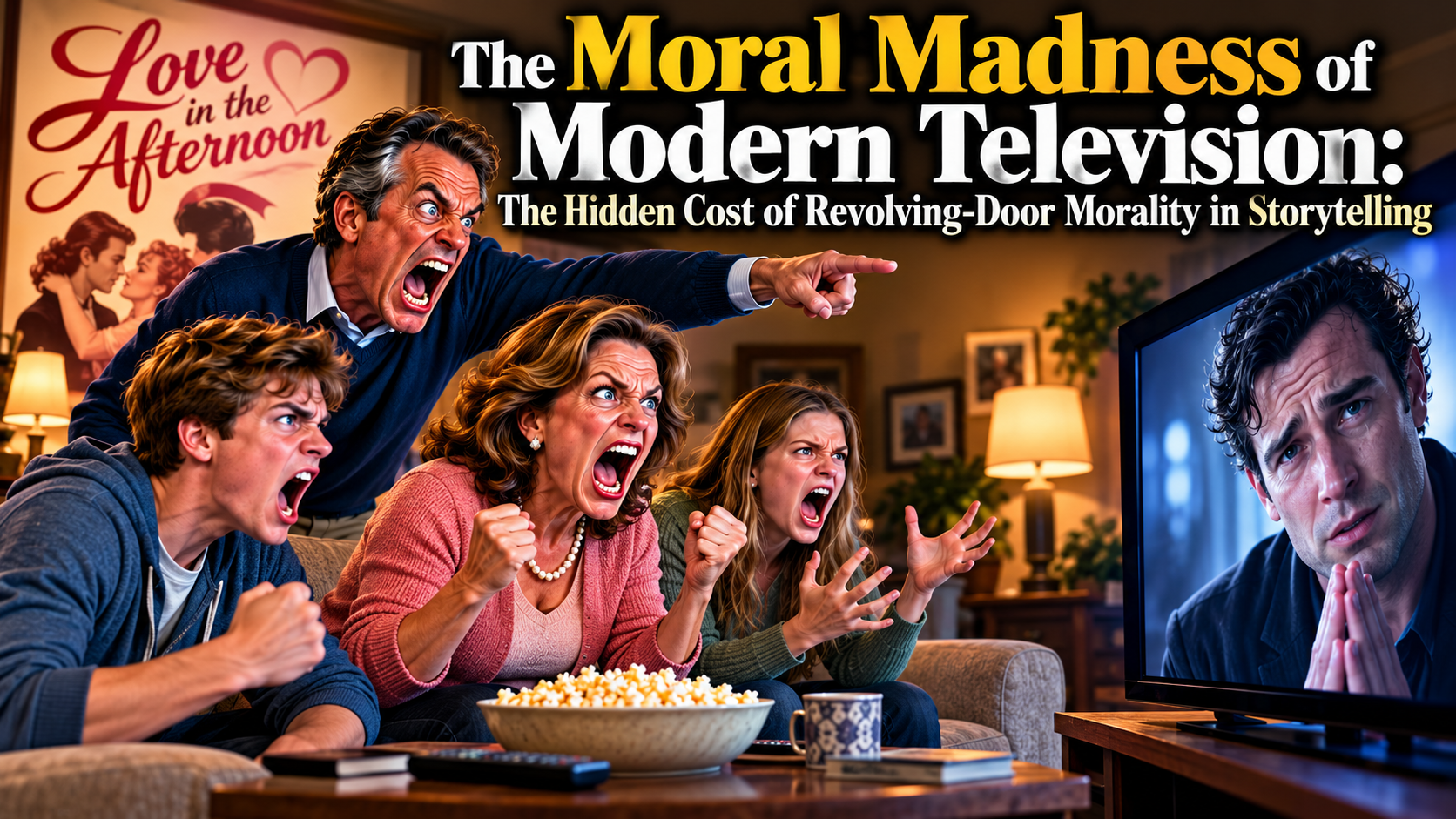
Love in the Afternoon?!
To understand this phenomenon, we should look backward. (Others may be able to go back even further than I for observing this pattern, and I’d love to hear from them.)
The practice of endlessly rearranging moral loyalties did not originate with modern science fiction or these modern supernatural dramas. It has a long and undistinguished history in the soap opera.
Let us not forget that in 1979, Luke Spencer (Anthony Geary) raped Laura Webber (Genie Francis) on the floor of a disco in the revolving story line of General Hospital. Astonishingly, the storyline subsequently transformed Luke from sexual predator into romantic hero, with Laura eventually falling in love with him and leaving her husband for him. Their subsequent 1981 wedding became a television phenomenon, attracting approximately 30 million viewers, one of the largest audiences in daytime television history.
Cheap & Comic Drama
Daytime television, cheap storytelling of the first order, perfected the art of keeping characters in perpetual emotional circulation with schizophrenic storylines and by running characters through a revolving door of personality and morality.
Lovers became enemies. Enemies became lovers. Marriages dissolved and reappeared. Characters have more marriages in their lifespan than an old-world Sultan with a wedding planner on speed dial. Children discovered previously unknown parents. Betrayals were exposed, forgiven, and repeated. Characters returned from apparent death, suffered convenient amnesia, concealed identities, and underwent astonishing changes of heart.
The machinery had to keep moving, grinding psychologically honest storytelling to tatters in its gears.
A soap opera running five days a week could not afford to resolve every conflict permanently. Genuine resolution, which normal people demand in real life, closes narrative possibilities. A marriage that remains faithful, a villain who remains imprisoned or gets the ultimate justice earned, a family that learns from its mistakes, or a character who achieves lasting emotional maturity may be satisfying and honest storytelling, but such developments also remove convenient sources of future conflict for lazy and exhausted writers lacking the necessary time for creating something brilliant. Conflict creates the story, satisfaction ends the story, and these stories NEVER end.
Consequently, the soap opera developed a remarkably addictive formula: generate emotional investment, disrupt relationships, offer temporary resolution, and then dismantle that resolution to begin again. The formula was not concerned with moral philosophy. It was concerned with keeping viewers returning tomorrow.
Evening Soaps & Who Shot J. R.?
We might be sympathetic given that soaps had 250 episodes a year compared to 25-30 episodes in nighttime dramas of that period. But when this same mode and method gets applied to these other types of shows a darker precedent is set.
Consider the machinations of J. R. Ewing in Dallas, or Alexis Carrington in Dynasty. Their betrayals, schemes, and shifting alliances became engines of continuing drama. Even so, there remained an important distinction. Those programs generally understood their schemers to be schemers. J. R. might occasionally demonstrate genuine affection or perform a decent act, but his underlying character remained recognizable. The audience was not expected to mistake temporary cooperation for permanent moral regeneration.
Soap Methods Go Mainstream
The more troubling development occurs when soap-opera machinery is imported into dramas that present themselves as psychologically sophisticated and morally serious. Shows that present only 8-20 episodes a year, that have the time for better storytelling but opt out of it.
A modern serialized drama may depict murder, torture, genocide, or other atrocities with extraordinary emotional intensity. It invites us to treat these events as morally consequential, only to borrow the soap opera’s convenient mechanism for erasing their consequences when the next storyline demands it.
The result is a peculiar hybrid: the emotional gravity of tragedy combined with the moral memory of a house plant.
So… what are we learning to forget?
The most troubling question is not WHY television writers repeatedly manufacture these moral absurdities—I don’t need conspiracy theories, though Hollywood has a poor record when it comes to the intentional unraveling of the moral structures of the western world—the most troubling questions concern what happens to audiences who consume this storytelling patterning year after year in show after show unawares. And I ask this as a fan of good storytelling in every genre.
If we repeatedly watch murderers become heroes through little more than a tearful apology, or a weak excuse—”Oh golly gee willikers, I thought if I cut down your sister like a hog for the slaughter the dome would come down… my bad. Since the dome didn’t come down, I sure am sorry I did that”—are we gradually learning to confuse expressions of remorse with repentance?
If we applaud the restoration of trust where no evidence of trustworthiness exists, where choices are disconnected from basic human character, are we becoming less discerning about whom we trust in real life?
If we are encouraged to excuse atrocities committed by characters we are told to love while mercilessly condemning characters we are told to despise for radically lesser offenses, are we rehearsing a dangerous habit of moral favoritism and moral relativism?
And what of forgiveness itself? Does its repeated reduction to a convenient emotional transaction diminish our appreciation for the genuine moral struggle involved in repentance, reconciliation, and restoration? Does it unravel the very concern for real justice in society? Do we learn to accept reasons as excuses and then make excuses for the wanton evil of our favorites?
“Come on Bud, he made a mistake when he chopped up your sister like a Thanksgiving turkey… thought the dome would come down… forgive and forget! Why you still hanging on to that? You got a real serious soul problem if you can’t let it go and partner up.”
Might we eventually become less offended by evil, not because we have carefully reconsidered our moral convictions, but because we have grown accustomed to seeing evil explained away and forgotten? “He should not be held accountable for his evil because you see, he acted in ignorance… confusion… passion… hurt… trauma, etc… ad nauseum.
He had reasons, and our modern toxic empathy demands that society accept reasons as excuses… if, that is, you are part of the “right” group.
The Sky Isn’t Falling But Still… What if?
These are not accusations against every viewer, nor are they established psychological consequences of watching such programs. I myself am a big storytelling fan, and take great pains to consider storytelling methods in a variety of mediums throughout history.
For example have you noticed how many popular shows (The Marx Brothers (1905), The Three Stooges (1922), The Bickersons (46-51), Honeymooners (55-56), All in the Family (71-79), Benson (79-86), Married with Children (87-97), and It’s Always Sunny in Philadelphia (2005-2026… so far) are little more than slightly wittier versions of Ye Olde Punch and Judy puppet shows, which were extracted in England from Italian Commedia dell’arte programs working characters like Pantalone and Pulcinella?
Did you know that our English word pants is not a plural, but, rather, a possessive because Pantalone wore this type of garment on his legs? We are all wearing Pantalone’s… shortened to pants. (You’re welcome!)
I am rather asking questions about the possible cumulative effects of repeated uncritical and undiscerning exposure to a particular pattern of Revolving-door moral storytelling in genres that do not, unlike sitcoms, operate on episode resets. I’m concerned with this method imported into long stories telling a single tale broken into episodes merely for the ease of serial release.
But there is an even more uncomfortable possibility?
What if we are not simply becoming less sensitive to wrongdoing? What if we are becoming more easily manipulated in our judgments of wrongdoing? What if our very capacity to think critically is being eroded in favor of emotional thinking alone?
What if we are being groomed to perceive real-life heroes as villains?
Modern storytelling has, for instance, transformed many of civilization’s essential contributors into stock villains: landlords become parasites, bankers thieves, employers exploiters, and police officers oppressors, property developers are all greedy profiteers destroying neighborhoods. We could spend all day detailing the abuse heaped in modern entertainment on lawyers, corporate executives, business owners, investors and shareholders, insurance companies, debt collectors, manufacturers and industrialists, as well as merchants and retailers. And let us not forget that most devilish of all institutions… Parents… always keeping their children down with rules and discipline and structured consequences… how will society survive it all???!!!
What if we are being groomed to perceive real-life villains as heroes?
For modern storytelling has been equally industrious in transforming yesterday’s villains into today’s heroes. Violent and destructive revolutionaries who would rather reign over a burning garbage dump than be common in a paradise are made into liberators. Criminals become victims of an unjust society. Vigilantes become champions of justice, and rebellious adolescents become profound philosophers whose greatest obstacle to enlightenment is having parents. Promiscuity becomes empowerment, adultery becomes self-discovery, selfishness becomes independence, and abandoning one’s family becomes a courageous journey toward personal fulfillment. Activists who regard marriage and motherhood as instruments of oppression become heroic champions of freedom. Cynicism is mistaken for intelligence. Contempt for authority becomes moral courage, and narcissism is rebranded as authenticity. The drunk is merely misunderstood, the thief is redistributing wealth, the vandal is expressing his deep inner self and must be heard. The anarchist is building a better world by tearing his own apart.
Apparently, the secret to becoming a modern hero is simple: reject responsibility, ridicule virtue, dismantle tradition, and blame whatever remains of civilization for the consequences. And whatever you do, never let a little thing like morality interfere with your moral superiority!
Now, it is not as if the audience is consistently taught that murder is acceptable or betrayal is admirable. Something potentially more insidious occurs. We are encouraged to condemn or excuse the same conduct depending upon the character committing it, the emotional atmosphere surrounding it, and the sympathies the writers wish to evoke.
Let a character strike a level five emotional face of hurt feelings or honest regret and we are ready to burn the world down and clamor for the killing of whatever character drew such an emotionally stirring response from that dear hurt soul… murderer or sexual deviant though he or she be.
We are not necessarily being taught that there is no right or wrong. We may be being groomed to let someone else decide, moment by moment, what deserves our outrage and what deserves our forgiveness based on nothing less than hyper-emotionalized and psychologically-manipulative storytelling.
Perhaps this deserves at least a little consideration.
Now, is This an Accident—or the Point?
The simplest explanation, as noted above, is commercial. Soap operas perfected the manufacture of endless conflict because endless conflict keeps audiences returning, and returning audiences generate advertising dollars. Contemporary serialized dramas have inherited those techniques, often intensifying them with greater violence, darker subject matter, and more psychologically elaborate presentations.
A compelling villain is too valuable to discard. A stable relationship offers fewer opportunities for tension and sensational betrayal. A genuinely resolved moral crisis cannot be endlessly exploited through recycling.
From this perspective, revolving-door morality is simply cheap storytelling with an attractive return on investment. But does that explanation account for everything?
Again, consider that some writers and producers are deliberately challenging traditional moral categories. The repeated blurring of guilt and innocence, victimhood and villainy, forgiveness and exoneration is often an expression of the creators’ own moral philosophies and desire for social engineering. Activist writers are the WORST!!!
Just so, could the practice reflect a broader cultural tendency to replace universal judgments about conduct with tribal judgments about identity, sympathy, or group loyalty?
And if audiences become increasingly accustomed to having their morals emotionally directed by sympathetic portrayals rather than consistent principles, might that make them more susceptible to similar techniques outside the fictional world—in advertising, political persuasion, journalism, or social movements? Is it possible to turn viewers into useful idiots for the causes of those activists telling the stories?
Let Us Consider
We should be careful here. The existence of a pattern does not prove a coordinated purpose. Nor does a possible psychological consequence establish that everyone involved specifically intended to produce it. Such claims require evidence.
Some simply follow established conventions, imitating what has come before without giving much thought to the assumptions they are perpetuating, the messages they are reinforcing, or the consequences of either. They are not necessarily advancing an agenda so much as uncritically reproducing one they have never thought to question. I.e. Some writers are little more than useful idiots themselves.
But we should be equally careful not to assume that every recurring cultural influence is accidental simply because its intentions have not been confessed out loud, or revealed in a stolen diary.
There are at least three possibilities: 1. the effect is unintended, 2. the effect is recognized but tolerated because the technique is profitable, or 3. the effect is deliberately sought.
Different programs, writers, and producers may fall into any one of these disparate categories but the outcome will be the same for society. We may qualify 1st degree murder, 2nd degree murder, involuntary manslaughter, and negligent homicide but all four result in corpses of people that should have been allowed to live out their days. Just so, when civilization crumbles from moral corruption it won’t matter which rationale one proffers for their participation in that demise.
The Most Important Character Is Watching the Screen.
We are the most important characters in the storytelling experience. So, we should pay closer attention to what these dramas are asking of us and what we are willingly bequeathing of our souls to them.
The next time a beloved character commits an atrocity, observe your outrage. When the writers offer a sympathetic explanation, examine your willingness to excuse him. When his victims welcome him back, consider whether their forgiveness is just. When he becomes the hero once again, ask yourself whether you have witnessed genuine transformation or simply surrendered your judgment to the emotional demands of the scene. And when the inevitable betrayal arrives again, consider how easily you can be persuaded to repeat the entire emotional performance.
Are we thinking about what we watch, or merely feeling what we are told to feel?
Are we exercising moral judgment, or allowing the story to exercise it for us?
Are we becoming more discerning about the complicated nature of human goodness and evil—or simply more comfortable with revolving moral contradiction?
And if we spend hundreds or thousands of hours practicing these emotional reversals in fiction, can we be certain that the habits never follow us into reality?
Perhaps revolving-door morality is nothing more than lazy writing, the exhausted machinery of the soap opera repackaged for modern audiences. Perhaps it is something more deliberate. But even if it is merely cheap entertainment, we should not assume that its influence is also cheap.
They offer us evil without lasting guilt, redemption without lasting transformation, and trust without evidence of trustworthiness. They ask us to experience outrage without memory, and to deliver fury or pity based on nothing more morally substantive than a tearful eye in an overwrought character.
The question is not simply whether we are willing to keep watching. The question is what we may be teaching ourselves to become as we do.
~Andrew D. Sargent, PhD
Discover more from Biblical Literacy with Dr. Andrew D. Sargent
Subscribe to get the latest posts sent to your email.