


Fact are Facts
AI is here… is still coming… and will be ubiquitous in the future. This is not a pro-comment. This is not a con-comment. This is… barring a complete collapse of civilization… a fact.
Facts don’t have to be liked or disliked. Facts just are, and wise people deal wisely with them.
Testosterone and Woman
Consider a couple of facts that tend to provoke people.
Testosterone levels in males have been declining globally for decades, even after adjusting for age, with the decline observable even among teenage males.[1] Men are also substantially stronger than women on average, particularly in the upper body.[2]
Neither fact asks what we think about it. Neither disappears because someone finds it politically or socially inconvenient. The facts come first. The difficult question comes next: What should we do about them?
Declining testosterone might be welcomed by someone who associates testosterone with “toxic masculinity,”[3] while someone else sees the same decline as a problem whose causes should be discovered and remedied. The fact has not changed; its interpretation has.
Likewise, the physical differences between men and women do not by themselves tell us precisely how we should organize sports, occupations, marriage, bathrooms, locker rooms, or anything else. Those are questions about what we should do with a fact, not whether the fact exists. We can argue about those questions. What we cannot profitably do is pretend reality changes according to our preferred conclusions.
Meanwhile Back on the Facts Ranch
Which brings us back to our first uncomfortable fact: AI is here. It is still coming. Barring a collapse of civilization, it will be ubiquitous.
So raging against that fact accomplishes very little. The important questions are what we should do about it, how we should respond practically, what we should safeguard, and—perhaps most uncomfortably—what the existence of AI should cause us to rethink.
A Serious Disappointment in Life
I partnered for many years with a gifted musician friend, who accepted all the help I would give in his own writing desires… apart from song writing. During all this time, I expressed an interest in becoming a writing partner with him with lyrics and song creation as well. I had many ideas about musical projects that would be beneficial to the church. I was dismissed out of hand… too ridiculous an idea to even consider it, I guess.
I wrote a song. A pretty good one. Not great at the time, but a solid start and a solid premise. He flat out refused to help me put it to music.
But I had a creative vision for it… and for much much more. I had waited long enough for help that was not coming. I used AI to make the song, crafting it as best I could with the tools I had available to me.
AI is a tool for MY OWN CREATIVE DESIRES. Decades of wanting and not having… longing and being thwarted were ended when this tool was developed. Now I am ready to go off like a rocket making all the things I could get no help in making in decades past.
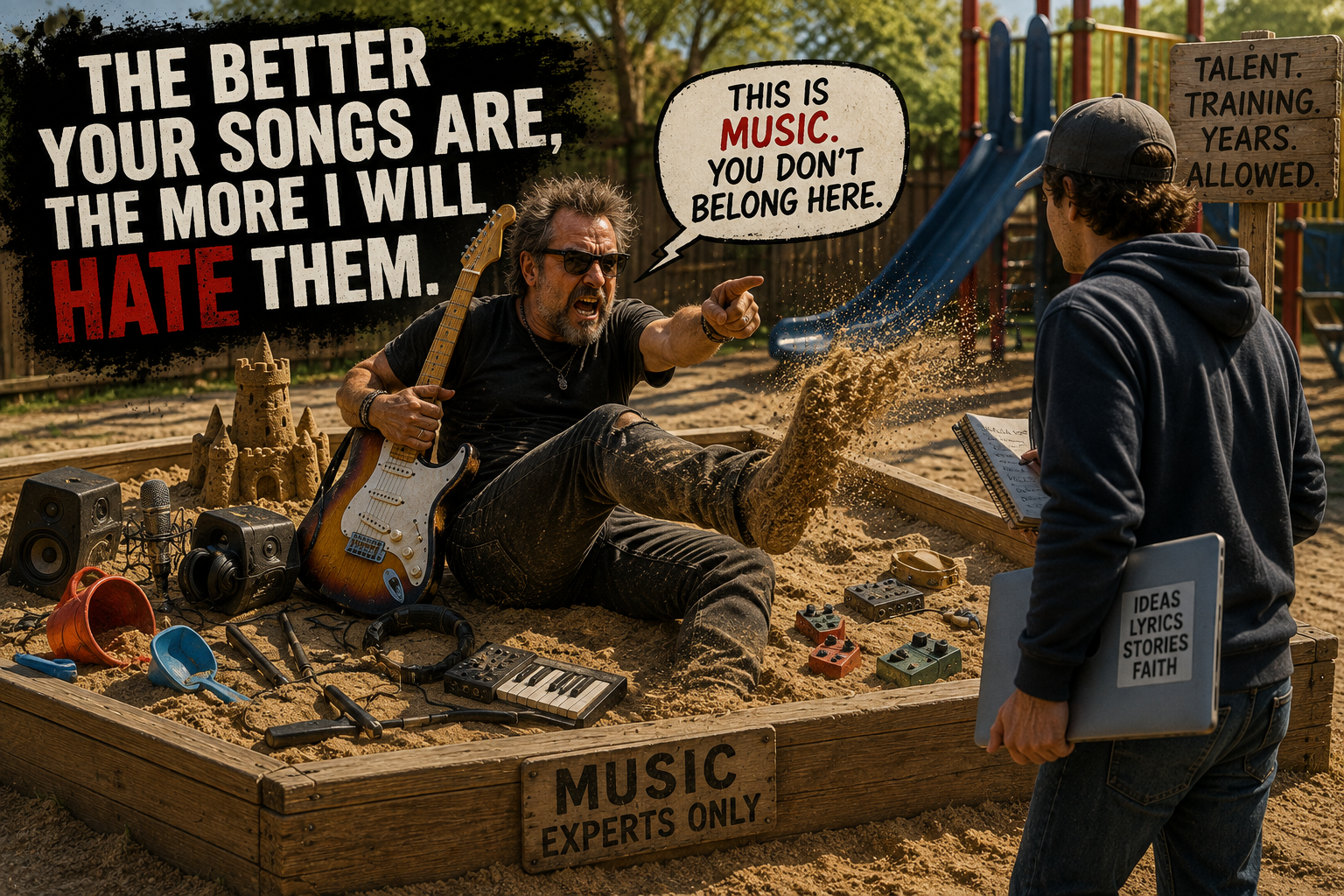
He was less than gracious when I shared the song with him… even though now it had artistic vision cast over it which was supposedly some missing component preventing his interest prior. He was indignant. AI creations were fake. He spouted off many of the easily dispelled lies about AI and how it works. He tried to cast the issue into something he thought would move me away from my musical projects, “How would you like it if someone used AI to write books?” He actually said, “The better your songs are the more I will hate them.”
Seeing Patterns that Need Understanding
Now he is not alone among musicians in these feelings. Many have sought to close ranks and keep out AI competition, refusing to help on any project where it was used, and casting dispersions on those who use it, calling them fakes and thieves… cheats.
Now, I will not bother to defend against such accusations here. I have written on this previously, and you can read my comments on my blog at DrAndrewSargent.com. There is very little that AI does musically that musicians and composers do not themselves do in the creative process. AI just does it faster and with a much greater knowledge of musical history from which to innovate—and it does it without the pompous drama that sometimes attends human artists. In fact, many of the very musicians who hate AI and despise those who use it have long ago yielded their souls to the mechanical and digital in almost every other area of art and music. They draw the line here, however, because AI circumvents their gatekeeping inclinations.
The Better Your Songs are The More I Will Hate Them
What I really want to talk about today is what this statement “The better your songs are the more I will hate them” is really saying in the face of the fact that AI is here… is still coming… and will be ubiquitous in the future.
Jealous and angry musicians need to consider in their own souls, especially Christian musicians, what they are really saying through any such sentiment. Like, “I worked hard to develop these skills. It’s not fair that you be allowed to compete without putting in similar effort,”[4] for, even this, disregards the talents of so many who make their own efforts meaningful through skills other than learning to play or sing. Writers, editors, technicians, etc…
Big Mike and Big Heads
I recently released a song for a friend. He wrote this song in the 70s. He has presented it to many over the years. He sang it for me over a restaurant table. I liked it. I asked permission to produce it. It’s called Big Mike and I have gotten some wonderful feedback from those who have heard it. So… in some 50 years of wanting, I was the first person to help. There must be a merit badge for that somewhere.
This is a complaint that I have heard from many who regard artists as difficult, arrogant, selfish. Artists tend to cultivate a sense of self where they are special and that the common mortals around them are unworthy recipients of their creative gifts… that they deserve accolades and special treatment… deserve to be served rather than to be called upon to serve others… help others. Artists often reserve a special kind of resentment for lesser talents who are foolish enough to think that they can play in their sandbox.
And yet, these “fools” have things to say. True things. Biblical Things. Valuable things. They have the skills to put them into lyrics, or the creative vision to cast them into pictures and music. They have historically gotten little to no collaboration from singers and musicians and artists in those endeavors, however, which actually diminishes the blessings that could be visited upon the world and believers. It is a sorrow and great loss that fewer rather than more collaboration are forthcoming.
Then, when those bursting to create are given a venue for that creation, the “elite” creators despise them even more… plot against them to silence them… cast dispersions to discourage them and demean them, blacklist them to shut them out… and turn on any in their own ranks who say, “Actually, that’s a really good song, maybe I should help them make it with live musicians and singers.”
What Are You Saying?!!!
If you say, “The better they are the more I will hate them!” What are you really saying?
If you say, “The better they are, the more I will hate them,” what are you really saying?
The more this song might bless the church, the more I will hate it.
The more worshipful this song is, the more I will hate it.
The truer this song is, the more I will hate it.
The more instructive… the more beautiful… the more edifying… the more effective for the Gospel this song is, the more I will hate it.
That is a revelation of a sickness in the soul born out of jealousy and self-importance to the detriment of the church. It reveals a level of self-worship that plagues many creatives. It reveals the depths to which some will sink when their own sense of specialness is threatened.
And no believer has any business cultivating that sense of self. It stands opposed to the Gospel of Jesus Christ.
I Spit on What God Call You to Do!!!
Let’s go further. When I was in prayer one day and whining at God… like I sometimes do… I was expressing my own frustration over the paucity of real substance in most (though certainly not all) modern Christian songs. And I felt like the Lord spoke to my heart… well, to be honest, I felt like the Lord slapped me up the back of my head and chastised me.
Because while so many Christian musicians think you shouldn’t be allowed to participate if you can’t sing or play, I think you shouldn’t be allowed to participate if you have nothing substantial to say… no biblical understanding to draw upon when saying it… no theological skill in understanding what you say… or suffer from a moral and/or ethical dearth of soul… for character is destiny.
Many Modern Worship Songs be Like…
I was fuming out things like:
Nobody objects to cotton candy because it tastes good. It just has nothing to offer the body beyond that initial taste. Emotion is wonderful in Christian music; it just isn’t nutrition.
Imagine a groom whose entire vow is, “You make me feel amazing. I feel you here. I feel your love. I just want to be near you.” Romantic? Certainly. But after five minutes, you’re wondering whether he actually knows or values anything about the woman he’s marrying. That’s a lot of modern worship music.
So many Christian songs sound like love letters that could be mailed to either Jesus or your girlfriend without changing many of the words. That’s a useful test: How many lyrics would have to change before secular radio would like it? My daughter was once enthralled with a famous Christian song without knowing it was about Jesus… or done by a Christian artist.
Imagine a restaurant where the lighting is perfect, the music is moving, the waiter is sentimentally crying. The chef comes out and hugs you. Everybody agrees it was an unforgettable experience. Unfortunately, nobody served any food.
Imagine a sermon where the preacher says nothing but “God is good. He’s so good. Really, really good. I just feel how good He is.” Nonsense! But put a guitar under it, sing it six times, and you’ve got the newest hit for morning worship.
Imagine a mathematics textbook that says, “Don’t worry about the answer—experience the equation.”
There are areas of life where feeling deeply about something is not a substitute for knowing what is true about it… and worship is one them.
Meanwhile Back at the Whinefest
So, I’m whining to the Lord and out of nowhere like a cuff up the back of the head by a passing motorist, I feel the Lord say to me, “So do something about it and stop whining.”
So I started doing something about it. I’ve done some 75 things about it in the last 18 months. I’ve got plans for hundreds more things I intend to do about it.
We talk endlessly about what AI might take away from established creators and much less about what it gives to people whose creativity was previously constrained by their dependence upon established creators.
Open the gates and let the people join in the chorus without needing the validation of those eager to stamp out competition through jealousy or arrogance… for most of them have failed us for decades.
But what is the response by people who claim to be Christian musicians not just to me but to anyone else who dares play in their sandbox?
The better, truer, more beautiful, more beneficial, more worshipful, you are in fulfilling what God has called you to do… the more I will hate it… the more I will try to thwart you in your work rather than help you reach more.
If that is your attitude, dear musician or singer, look into the holy mirror of God’s word, see yourself, and repent in dust and ashes.
If you are open, however, to the increased opportunities that are before you in songs crafted by those who would use AI to cast a musical vision, then may I suggest that you dedicate at least some of your talents to scooping up the best of the best and helping.
As one who has helped many achieve their writing goals in other venues, I can assure you that this would be a blessing to the larger Church of Jesus Christ. And isn’t that what being a Christian artist is supposed to be about?
~Andrew D. Sargent, PhD
[1] Serum testosterone levels appear to have declined among men globally over the past half-century. A recent systematic review encompassing more than one million healthy men found a significant temporal decline that persisted after adjustment for age, BMI, and differences in testing methods. The causes remain uncertain, and the magnitude of decline is not necessarily uniform across populations. ¹ Daniele Santi et al., “Temporal Trends in Serum Testosterone and Luteinizing Hormone Levels Indicate an Ongoing Resetting of Hypothalamic-Pituitary-Gonadal Function in Healthy Men: A Systematic Review,” Journal of Endocrinological Investigation 48 (2025): 2721–2734; Thomas G. Travison et al., “A Population-Level Decline in Serum Testosterone Levels in American Men,” Journal of Clinical Endocrinology & Metabolism 92 (2007): 196–202. Lokeshwar et al. (2021): specifically demonstrates that the decline is also observable among adolescent and young adult males, beginning at age 15.
[2] Adult female upper-body strength averages roughly 55–60 percent of adult male strength, with the large sex difference emerging principally during puberty. The difference has been observed across countries and generations and persists despite physical training. James L. Nuzzo, “Sex Differences in Grip Strength From Birth to Age 16: A Meta-Analysis,” European Journal of Sport Science 25 (2025): e12268; David J. Courtright et al., “A Meta-Analysis of Sex Differences in Physical Ability,” Journal of Applied Psychology 98 (2013): 623–641.
[3] Clinical psychologist and psychoanalyst J. Herman Kleiger has explicitly connected declining testosterone with what he regarded as a beneficial softening of masculinity. Reflecting on his elderly father, Kleiger described the fading of his father’s “testosterone-driven script” as accompanied by greater tenderness and emotional openness, presenting the change as a humanizing movement away from “toxic masculinity.” J. Herman Kleiger, “Masculinity Isn’t Machismo: Why Macho Needs to Cry,” guest essay on Rachel Thompson’s blog, October 31, 2021.
[4] Of course, guitarist and pianist friends don’t hesitate to use drum machines. Pianists and drummers don’t hesitate to use guitar samples. All are ready to employ synthesizers or electric instruments.
Discover more from Biblical Literacy with Dr. Andrew D. Sargent
Subscribe to get the latest posts sent to your email.