

A Little Boy’s Artistic Dreams
When I was young, I began studying privately with a gifted artist. She was old. Her house was also old and of good size. Every room that didn’t contain her intentionally-sparce furniture was stacked several canvases deep filling every space side to side with her life’s work. She did it for the joy. It’s hard to count the years with precision back then, but I estimate that I spent upwards of 6 years of Saturday mornings in her company learning to draw and paint. She used oils. So I used oils. And I am, to tell the truth, a bit of a snob against acrylic paint… but not watercolors. I love watercolors.
I remember the day I quit. A new student had started as an adult and within six months she was better than I was. I behaved like an infant… a jealous and envious child taking an inner temper tantrum. My teacher tried to explain that as I grew into adulthood, I too would find my skills radically improving. She was right. My skills increased almost on their own as I kept at it without her, but I wasn’t listening at the time. I was reacting emotionally and didn’t want to hear facts or logic… my injured pride had reasons that reason knew nothing of.
At the Creative Crossroads
As I got yet older I found myself at a crossroads. I had been on a traveling drama team and loved the performance arts. I still had decent skills with a pencil and brush and thought to pursue the arts in that way too. I also had a passion for the word and wanted to dedicate my life to understanding and teaching it. I made a choice and that choice meant limitations. I became a biblical scholar, professor, teacher, and pastor.
Leaving the Arts That Wouldn’t Leave Me
My intuitions in life affected the way I did scholarship. Much of the Bible is poetry, what we commonly, even if misnomered, call “right-brained.” My training as a scholar, however, is best described by its companioned opposite, “left-brained.” The irony of “right-brained” literature being the bailiwick of largely “left-brained” scholars has never escaped me, but I think my own natural orientation helped me in that regard.
But still, I did make a choice and left the arts behind for the most part. They, however, did not leave me behind. I have always had artistic designs for what I do… ideas about presentation where the arts would be useful to me… especially as I’ve turned toward social media to find an audience for my materials.
Clocks, Calendars and a Long Artistic Longing
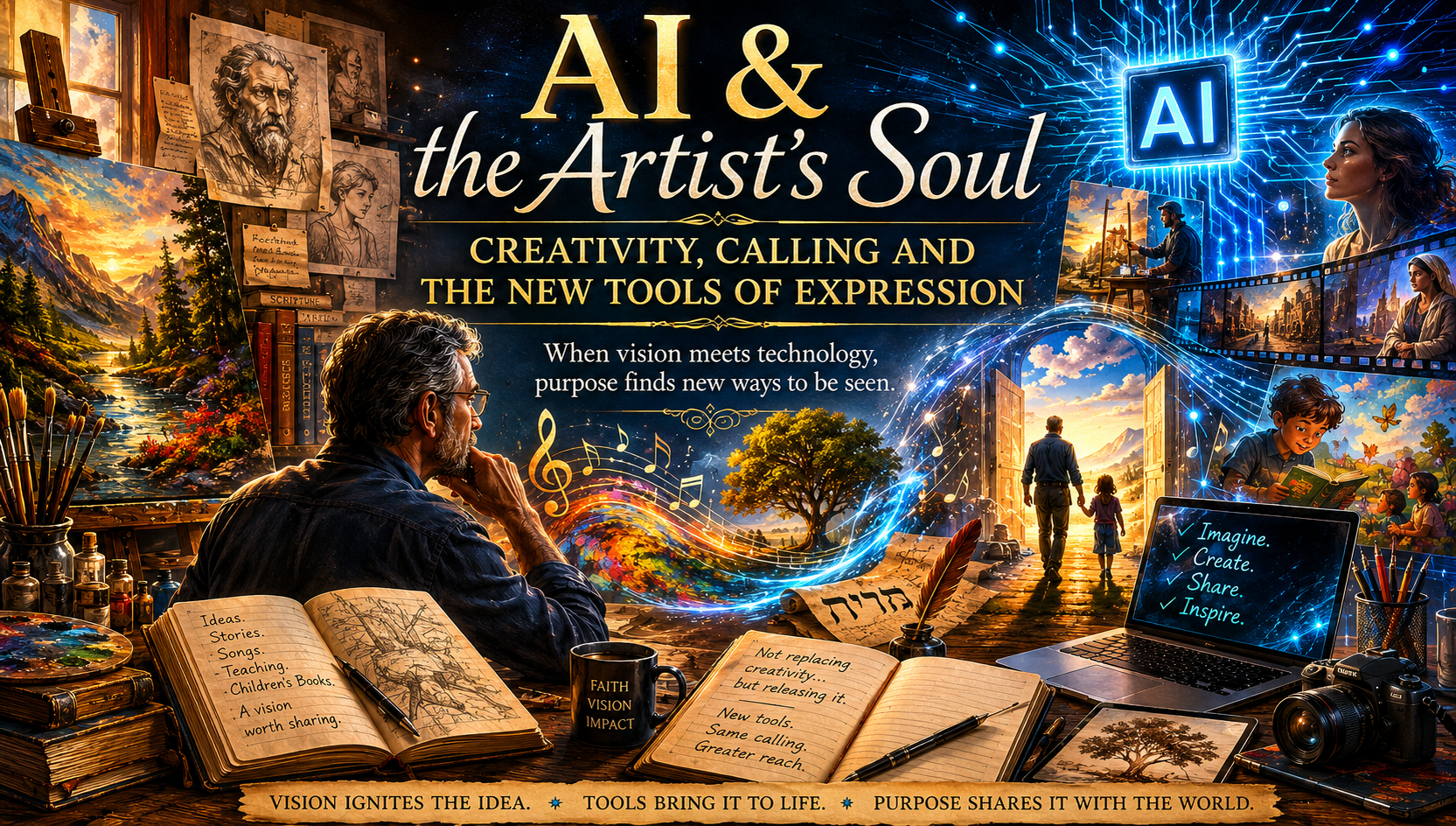
I have hundreds of articles that benefit from creative featured images. I write poetry that almost demands strong images to go along with it. I have long desired to express myself in song, though the years did not permit the mastery of singing or instruments. I have written a musical on the book of Ruth that I wish to present first as an animated movie of sorts. I have developed a system for learning Hebrew vocabulary speedily that uses witty artistic images that I designed long ago at my art desk while teaching, but have yet to produce more professionally. I have many children’s books that I’ve written and designed in my head. I think they would do well. I’ve needed book covers and thousands of teaching illustrations that I can see in my mind’s eye quite clearly.
Knowing that my study, writing, and teaching is quite demanding on my time (I have worked for many years at a time for some 80-100 hours a week trying to keep my ministry irons hot in the fire) I continued to make hard choices. I have not cultivated my manual skills as much as I might have wished (though I am still good with a pencil) so I have had to seek help from others. And this is what seeking help from others often looked like:
- “I have this project. It promises good returns, but I don’t have much to pay up front for your artistic skills. Can we work something out?”
Answer, repeated well over a dozen times through the years: “No. I only do things I get paid for up front.” - “Sure, let me look at the drawings and I’ll make professional final images from them.” or “Sure, let me have those song lyrics and I’ll put them to music.” Then nothing happens… because their time is also limited and paid work understandably takes priority.
- I spent thousands of hours helping others with projects in my own areas of expertise, then when I ask for assistance in return. Frequently the answer was simple: “I’m too busy with my own work.”
My Kingdom for a Team!!!
For over 40 years of ministry in one facet or another, many of my desired projects have lain dormant. And that is a sadness and a frustration to me that is hard to adequately express. I need a team. I lack the money, the organizational & financial skills/focus necessary to afford a team. But I do not lack the artistic vision for what I know I could produce with that team if I could gather it… if I could pay for it.
Many of us are not lacking vision, ideas, discipline, or willingness to labor. We are lacking access to specialized talents. Until recently, we were dependent upon talented people who often had different priorities, different ambitions, limited time, or personalities that make sustained collaboration difficult. The result was that countless worthwhile projects remained trapped in notebooks, outlines, sketches, unfinished lyrics, lyrics without music, and a host of conversations about “someday.”
More Than a Whine-fest
Now it is important to understand that I am not just whining… though I’ve had my periodic whinefests with the Lord in prayer… and my wife has heard a good deal of it as well. I am explaining myself to those whose own sense of identity and importance as “protectors of artistic expression in the church” has often made them reflexively dismissive of the possibilities now opening through AI. That knee-jerk response is often mistaken as righteous indignation, but it is little more than the common historic gatekeeping that has attended every shift of artistic expression and technological advance in the history of man.
Free at Last…
AI, whatever its dangers and limitations, has begun altering that reality.
For the first time in my life, many of the things I could clearly see in my mind are becoming producible without first navigating the availability, priorities, finances, and collaborative limitations of a long chain of scarce and often difficult artistic specialists.
That is not the death of art to me. It feels more like the removal of a bottleneck that has limited my productivity for decades.
Or Am I???
You’re offended. You say, “Those with artistic talent have spent years honing their skills… they deserve their due.”
I agree, they deserve their due… and there will always be a place for talented people to give their talents. But ministry opportunities are finite, and I do not wish to spend my remaining productive years waiting for ideal circumstances that may never come.
You say, “we should refuse to use AI out of respect for those who have the skills it displaces.”
I disagree.
You Can’t Stop the Tide
Technologies that remove unnecessary barriers have always expanded what ordinary people are able to produce. This may threaten those with a guild mind who cherish scarcity, but it is a boon to productivity and influence for the Gospel. Take your pick.
Indeed, You may as well demand that we stop using computer processing programs like Word to honor typists who spent years honing their skills… Nay… we should have refused to have used typists who displaced scribes who spent even more years honing their skills. Smash the printing presses! Give every scribe, copyist, amanuensis, scrivener, illuminator, calligrapher their due.
Talant may shift its locus, but it isn’t wiped out. Ingenuity always pays, even if the focal point of that ingenuity shifts from highly inefficient human processes to machine-based production.
“But the arts are different,” you say. “Art needs soul,” you cry.
I agree, but the soul of the artist does not die just because it shifts its practical implementation. In these artistic endeavors of mine, I AM THAT SOUL. AI is just the tool that opens up a world of productive possibilities for me after decades of stagnation under the boot of scarcity. Wow… that was really melodramatic… but that’s how it feels to me.
The Best Assistant I’ve Ever Had
AI responds to ME! It produces for ME… instantly. AI doesn’t complain. AI is the best assistant I ever had. It fits easily within my budget, never tires, never cops an attitude. It’s there at 2 AM, 2 PM, and every other minute in between that I need it. Its production speed and skill is amazing.
AI listens to me as I learn to communicate my heart’s desire to it… to express my nuanced artistic vision through thousands of words of description…and then it responds.
AI answers my questions, teaches me how to develop my technical skills and how to effectively use dozens of artistic and technical platforms.
It makes striking images for my articles and PowerPoint lessons by the thousands. It will allow me to produce my Children’s books, my Hebrew vocabulary book. It will create excellent animations for my musical, and astounding demos for my songs.
Preserving Scarcity Has an Equal & Opposite Reaction
And here is the big crescendo. Does it displace artists in making those images? Those demos? Those animations?
NO. A thousand times NO!
I couldn’t get an artist to even consider doing any of it for me.
AI, however, made it all possible… and efficient… to the benefit of the Church and the spread of the Gospel of Jesus Christ.
So cast your vote. Expanded ministry for the gospel through empowering individuals the world over in their own creative venues… or the preservation of older guild structures of creative scarcity for the sake of protecting artistic gatekeeping?
Andrew D. Sargent, PhD
Discover more from Biblical Literacy with Dr. Andrew D. Sargent
Subscribe to get the latest posts sent to your email.