

In the world of the creative arts, like other fields of technical expertise, success is not always a matter of talent alone… sometimes not of talent at all. There are complex dynamics in play.
Lessons from Waifs and Art Liars
This is well illustrated in the movie, Big Eyes, which tells the real life story of Margaret Keane, famous painter of big-eyed waifs, whose art, Jane Howard called “The most popular art now being produced in the free world,” in her August 27th 1965 Life Magazine article, “The Man Who Paints Those Big Eyes: The Phenomenal Success of Walter Keane.”
Yes, you read that right. Margaret’s husband, Walter, took credit for her work and through his own marketing genius made her work the most talked about art sensation of a decade. Her work was despised by art critics who called it “kitsch.” But, when Walter outmaneuvered the traditional arbiters of artistic legitimacy by exploiting new avenues of mass reproduction and distribution, it was loved by the masses.
The dynamic of her life in art is important to grasp for my topic today. By my assessment, Keane’s success was only partly based on her talent and prodigious production. Without Walter, she would have more than likely remained in obscurity. Without Walter, she would have been thwarted by the gatekeepers of the art world.
What is a Gatekeeper?
A gatekeeper is an individual, institution, or system that controls access to opportunities, audiences, resources, credentials, recognition, or distribution within a particular field. Gatekeepers determine influence, or constrain who is allowed to participate, who receives attention, and what reaches the wider public.
Why is a Gatekeeper?
Gatekeepers exist because scarcity exists.
Gatekeepers of old existed because the means of communication were highly limited. Reaching the masses at all was difficult. Public gatherings and chatty neighbors, then public notice boards, and scrolls. The printing press was a huge leap forward for books, magazines and newspapers. Then came radio and Television. Each filtered access so that only “the most worthy voices” were heard. Yeah… that’s what it was… only the best of the best of the best got through… like Marx, Hitler, Lenin, Stalin, and Mao… quality voices like that.
Modern gatekeepers exist in a different form because communication has become comparatively unlimited and cost has plummeted. Thus, initial access is wide open… exposing just how scarce, how limited the attention of even 8 billion people can be.
Yes, human attention is finite, but the number of people desperately seeking it is not. There are more books than can be read, more songs than can be heard, more opinions than can be considered, and more creators than can be promoted.
Some mechanism is therefore needed to sift through competing claims for attention and influence, separating what is valuable from what is merely loud. Yeah… that’s what the algorithms do… only the best of the best of the best get a meaningful piece of the global attention pie… like those cultural giants lip-syncing other people’s jokes, explaining why you too should believe the world is flat, and Critical Marxists raging about how racist toothpaste is.
Love Live Gatekeepers?!
At their best, gatekeepers preserve standards, identify excellence, protect the public from fraud and incompetence, provide expert evaluation, allocate limited resources, and pass on valuable knowledge and traditions. The strongest defense of gatekeepers is that they help quality rise above the din of so many who go about screaming, “Look at me!” “Listen to me!” “Buy mine!”
Down with Gatekeepers?!
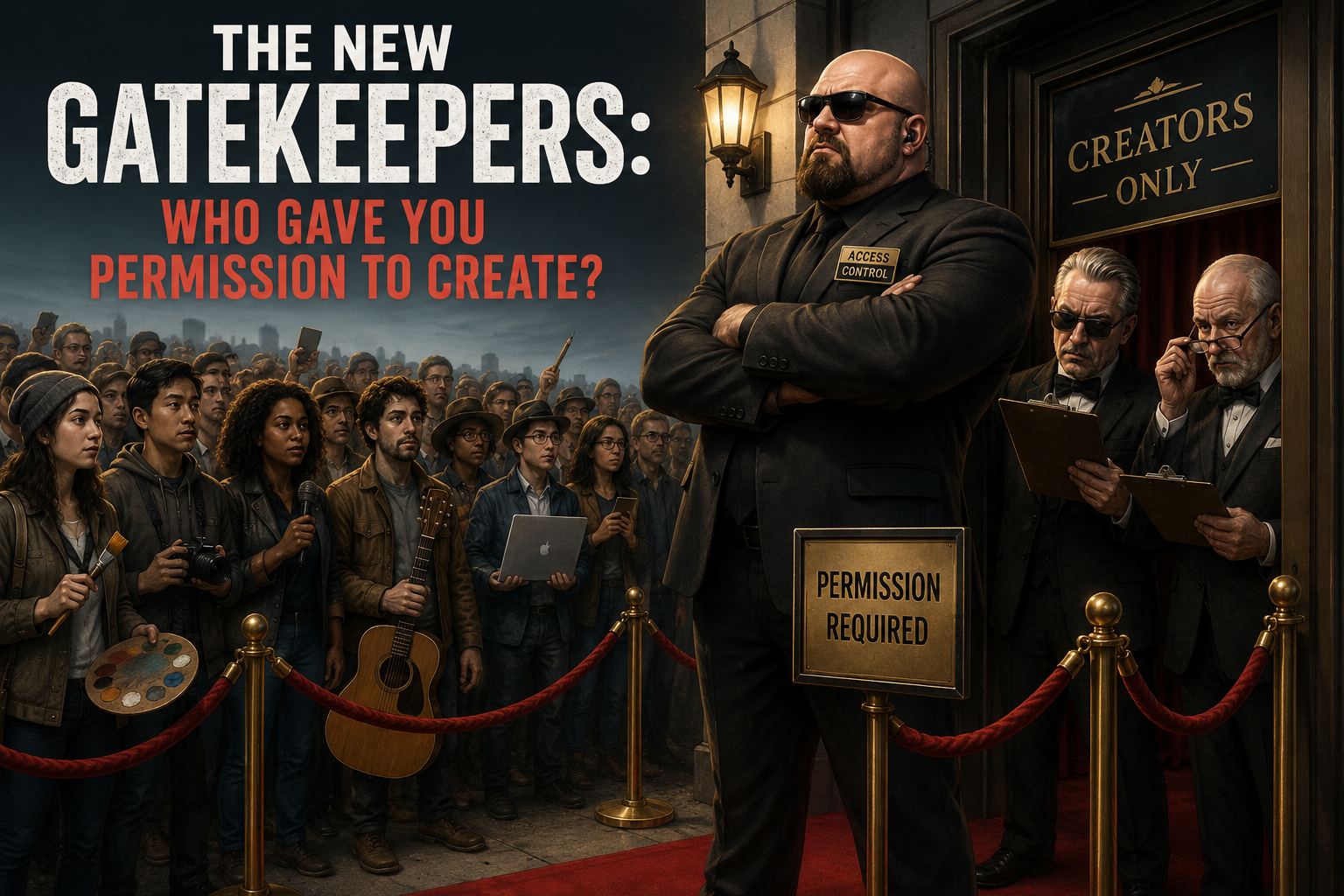
The danger of gatekeepers is that institutions created to protect quality easily become more concerned with preserving privilege than rewarding merit. What begins as quality control evolves into systems where the question is no longer, “Is it good?” but, “Who gave you permission to make it?” Gatekeepers routinely begin acting less like talent scouts and more like bribed nightclub bouncers who stop asking, “How good are you?” and start asking, “Who do you know?” or “Is your name on the list?”
The Noble History of Gatekeeping
History is filled with institutions that began as guardians of excellence but eventually adopted an “us four and no more” philosophy, guarding their position as zealously as they once guarded their standards.
Trade Guilds of old, for instance, often began restricting entry and blacklisting (often through violence and other forms of thuggery) to preserve scarcity for its own sake… maintaining control and artificially high prices. But a healthy society needs expertise to be both trustworthy AND abundant. When scarcity is preserved for its own sake, society receives fewer of the skills, services, and innovations than it needs. The result is not merely protected professions, but diminished productivity for all… dampening societal flourishing.
Universities frequently favor their own brand of orthodoxy over honest and methodologically sound inquiry, and even scientific institutions tend to bend under political or financial pressures. You know what “they” say… 9 out of 10 scientists agree with whoever is paying the bills. Even the most stalwart lab geeks are kept aware of what side of the beaker the butter is on.
And the Moral of the Story IS?
The lesson is not that gatekeepers are unnecessary, but that every gatekeeper eventually faces the temptation to concern himself with self-preservation rather than meeting the needs of civilization.
Everything is a tradeoff in real world activity. So there is a tradeoff of positives and negatives for having strong gatekeepers and for NOT having strong gatekeepers.
Gatekeepers reduce “noise” but also suppress talent. Open markets unleash talent but also allow a cacophony of competing voices most of whom are unworthy of attention. Gatekeepers are supposed to vet quality but also prevent many worthy “voices” from ever being heard. Open markets make it harder to find quality but allow excellence to emerge from unexpected places. It gets even worse when the criteria for being “acceptable” is based in credentials, connections, ideology, or institutional approval rather than in producing something good.
The challenge for us is not choosing between order and chaos but finding a balance where standards can guide the search for excellence without becoming barriers that prevent excellence from competing.
The Internet Broke the World?
Those who do not remember the birth of the internet cannot appreciate how much the world has been turned on its head by it. New markets have emerged that resemble the Wild West far more than the traditional systems they disrupted. The old gates have been blown open. The walls around those gates have crumbled.
Anyone can publish, broadcast, record a song, teach, promote, and compete. Almost every thinking adult and child has more production power and media access in their cell phones than entire networks could boast just a few decades ago. Every field of media and performance has been democratized beyond anything society could have even imagined when I was already an adult with two kids.
Predictably, this has produced an explosion of confident incompetence, a tsunami of mediocrity, and enough self-appointed experts to populate several small nations. But it has also provided an explosion of opportunity for those with the determination and skill to compete.
The noise is deafening, but for the first time in history hundreds of millions of people can place their work before the public without first securing the blessing of established gatekeepers who may or may not be searching for excellence… who may be merely protecting existing markets and existing players.
Will AI Also Break the World?
Beginning in 1993 while working on my first master’s degree, I watched the internet transform the world around me. And now, at almost 60, I am watching it happen again with AI.
Does AI scare me? Yes, in point of fact, it does. But one may as well be that king of old standing on the shore commanding the tide to stop coming in as to wage war against it. Like every technological transformation from the wheel to the printing press, from the steam engine to electricity, from radio to television, from card catalogues to search engines, computers to internet, AI will force us to reimagine our place in the world.
AI is a double-edged sword. It can liberate the imagination of those who have ideas but lack technical skills. It can also encourage intellectual laziness in those who begin outsourcing not merely performance but imagination itself. One person becomes more creative because of AI. Another becomes less creative because of it. Such tensions accompany nearly every technological revolution.
A New Class of Panicked Anti-AI Gatekeepers
So too, the debate over AI is often presented as a debate about quality, originality, or ethics. Sometimes it is. But the deepest fear surrounding AI is often existential.
For many people, their craft is more than a profession; it is part of their identity. Years of study, practice, sacrifice, and hard-won expertise become intertwined with a sense of significance. When new technology suddenly enables outsiders to perform tasks once reserved for specialists, the question is no longer merely, “Will this affect my income?” but “If ordinary people can now do what I do, what will make me special?”
This helps explain why debates over AI often become so emotional. The issue is not always quality, ethics, or even economics. It is often identity. The guild member who once welcomed excellence may begin defending scarcity as if their very soul depended on it. The question for them quietly shifts from, “Is this good?” to, “Should people like you be allowed to compete?”
We Don’t Care If It’s Good!
Not everyone who questions AI is motivated by such concerns. Some objections are thoughtful and legitimate. But when a song is rejected before it is heard (or admired until its source is discovered) … when a picture is condemned before it is seen, or a creator dismissed simply because AI was involved, the discussion is no longer about quality. It has become a debate over permission. The guild is no longer evaluating the work; it is evaluating whether the creator had the right to participate.
Many critics of AI are not merely rejecting a tool… in the arts most of them long ago accepted mechanical aides in their own work. (Cough, Cough, Synthesizers and drum machines) The line between “real creativity” and “technology-assisted creativity” has been moving for generations. The current debate is often less about whether tools should be used and more about which tools have become familiar enough to stop frightening us. Modern gatekeepers are, in truth, mostly freaked out that AI allows someone outside the guild to compete in the market with those who spent years acquiring scarce technical skills.
The Better It Is, the More We Will Hate It
We see just this scarcity guild mentality whenever a radio station refuses to consider a song because AI was involved at any point in its development. We see it when musicians refuse to perform a piece for the same reason. We see it when creators are treated as illegitimate not because their work lacks merit, but because they used tools that guild-approved creators fear. The question is no longer whether the work is good. The question has become whether the creator belongs to the approved class.
The Big Question of Criteria
The question before us is not whether we will have gatekeepers. The question is whether those gatekeepers will serve excellence or rig markets in their guild’s favor.
Every generation must choose what kind of gatekeepers it will tolerate. The healthy gatekeeper asks, “Is it good?” The unhealthy gatekeeper asks, “Did one of us make it?”
What’s Next?
Perhaps in my next submission, I will argue FOR gatekeepers… for MYSELF as a gatekeeper.
I wish to man the gates to keep the biblically illiterate, the morally challenged, and the theologically stunted from being allowed to make Christian music no matter how pretty they are, how well they sing, how creatively they compose, or how majestically they play. I think these are far more legitimate criteria than whether or not a song writer used AI to create a demo for his or her song.
And since few of those in Christian music have my credentials in Scripture and theology, that would be a hard day for the Christian Music industry.
Andrew D. Sargent, PhD
Discover more from Biblical Literacy with Dr. Andrew D. Sargent
Subscribe to get the latest posts sent to your email.