


A Weird Question
I was recently asked online, whether or not I had a biblical case for resisting ‘Toxic Empathy’? Was there, according to Scripture, any such thing as toxic empathy? I said yes to both.
But let’s rephrase. Would the authors of Scripture and the Holy Spirit that inspired them scold us for pushing back against those showing empathy to the hurting, to the dysfunctional, to the poor, to disadvantaged, to those in prison… (or seemingly destined for it by way of their societal ‘challenges’) even if said empathy allows unhealthy reverberations in the rest of society?
Let’s rephrase again. Would Scripture and God applaud the young man who said to me in the not-too-distant past, “God commands me to love, I’ll let God worry about the consequences of that love”?
Definitions Matter
At the risk of being overly difficult, may I suggest that the answer to this question may be found in part, in the definitions of terms.
Let me rephrase that. We know that Scripture speaks of compassion, mercy, grace, love. But to ask the question as to the biblicalness of resisting “Toxic Empathy,” might we want to define empathy and perhaps ask whether empathy itself is a biblical idea?
A Short History of Empathy
The word empathy is a relatively recent addition to the English language, coined in 1909 by the British psychologist Edward Bradford Titchener as a translation of the German word Einfühlung (“feeling into”).
The concept of Einfühlung (“feeling into”) itself had originated in nineteenth-century (1800s) German aesthetics, where it described the act of imaginatively projecting oneself into a work of art.
The German philosopher and psychologist Theodor Lipps (1851–1914) encountered the aesthetic concept of Einfühlung in the late nineteenth century and became its most influential psychological advocate. Beginning in the 1890s and continuing into the early 1900s, Lipps argued that Einfühlung was not merely our response to works of art but a general feature of human consciousness. He proposed that we understand other people by an unconscious process of “feeling ourselves into” (Einfühlung in) their expressions, actions, and emotions. In this way, Lipps transformed Einfühlung from a theory of aesthetic appreciation into a broader psychological account of how one person imaginatively apprehends the inner experience of another.
Titchener believed the English language lacked a precise term for this psychological process and intentionally distinguished empathy from existing words such as sympathy, pity, mercy, grace, and compassion.
Empathy vs. Compassion/Pity/Sympathy
Traditionally, although often synonymous, pity refers to sorrow for another’s suffering, sympathy takes another step toward feeling with a person, and compassion moves yet further towards acts designed to relieve said suffering.
By contrast, empathy was introduced as a descriptive psychological concept referring to understanding or sharing another person’s inner experience through imaginatively putting one’s self into the “shoes” of the suffering, and seeking to live in that reality to gain insight and understanding on a deep emotional level.
The Warping of a Word
During the latter half of the twentieth century, however, the concept of empathy underwent a significant cultural transformation. Influenced by humanistic psychology, therapeutic culture, the ethics of care movement,[1] and especially schools of thought descending from Critical Theory, empathy increasingly came to be regarded not merely as a psychological capacity but as a moral imperative.
In many academic, educational, and cultural settings, moral reasoning shifted from asking primarily, “What is true?” or “What course of action produces the most just outcome?” to asking, “How does this affect the lived experience of those involved?” It sanctified the lived experience of those morally, ethically, or socially marginalized by Western cultures… especially by the Judeo-Christian worldview that underlies it historically.
Within this framework, the act of emotionally identifying with another person’s experience often became a moral good in itself, at times taking precedence over questions of objective truth, impartial justice, or the long-term consequences of particular policies or actions.
Critics have argued that this elevation of empathy from a descriptive human faculty to an independent ethical authority represents one of the most significant moral shifts of modern Western culture.
A Biblical Response to Empathy?
In that light, the modern discussion of empathy and “toxic empathy” is about whether emotional identification with another person can become detached from truth and outcomes—a possibility the Scriptures repeatedly acknowledge in their warnings against misplaced pity and compassion.
Biblical writers speak in categories such as compassion, mercy, kindness, pity, grace, steadfast love, and bearing one another’s burdens. Scripture repeatedly commands believers to love their neighbor, show mercy, bear one another’s burdens, rejoice with those who rejoice, and weep with those who weep (Romans 12:15; Galatians 6:2), and Christ Himself is repeatedly described as being moved with compassion for those who suffer.
At the same time, the Bible is equally clear that compassion must never be allowed to override truth, justice, holiness, or obedience to God… with justice being defined by righteousness and even-handed applications of right and wrong and NOT by some slight of hand as “producing equal outcomes.”
Israel’s judges were repeatedly commanded, “Your eye shall not pity,” when carrying out righteous judgment in matters such as idolatry, murder, and other serious crimes, because misplaced pity can corrupt justice (Deuteronomy 7:16, 13:6-11, 19:11-13 & 16-21, 25:11-12). The rules of court specifically warn against setting aside justice based on pity for the rich or the poor, or one’s relational connection to the accused (Exodus 23:1-9).
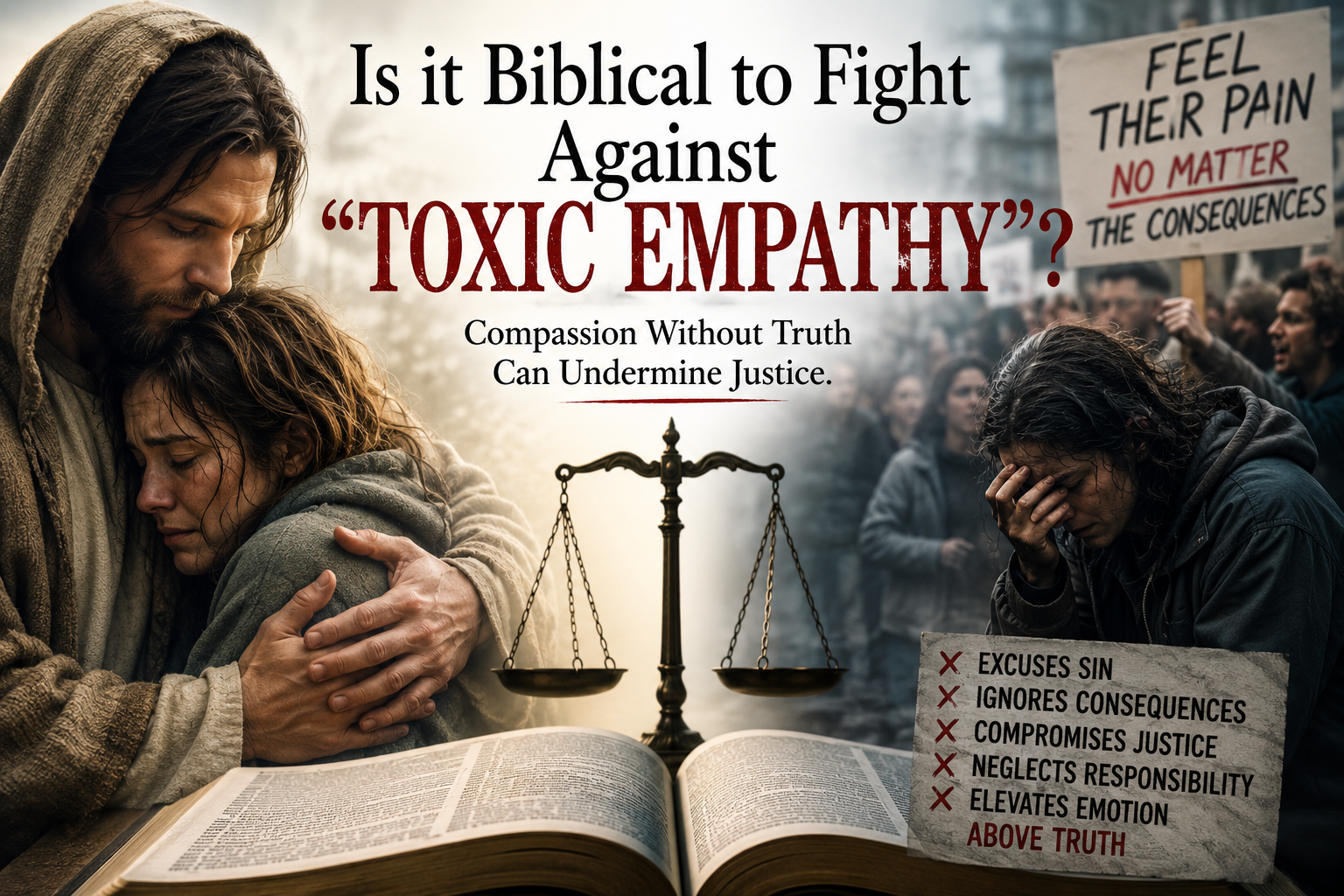
This is essentially what many people today mean by the expression “toxic empathy.” They do not intend to suggest that compassion itself is sinful, but that emotional identification with another person’s feelings becomes sinful when it excuses sin, ignores consequences, compromises justice, neglects responsibility, or elevates human emotion above God’s revealed will.
Thus, while the phrase “Toxic Empathy” is even more modern than the term “Empathy” itself, the underlying biblical principle is ancient: Scripture consistently commends compassion that is governed by truth, wisdom, righteousness, and justice, while warning against misplaced compassion that undermines God’s commands.
The issue, therefore, is not whether Christians should be compassionate—they unquestionably should—but whether compassion remains subject to God’s truth or is permitted to replace it.
So in terms of the present discussion, feelings of “empathy” that cause one to act in terms of what feels good regardless of outcomes… or acts in accordance with what one would foolishly wish for themselves were they to experience the negative emotions of natural consequences are by definition manifesting a toxic form of empathy. Love is to act for another’s actual good, NOT to act so that one feels good about what they do whether actually doing good for the other… for that is toxic empathy.
~Andrew D. Sargent, PhD
[1] Feminist psychologist Carol Gilligan and her 1982 book In a Different Voice, criticized the work of developmental psychologist Lawrence Kohlberg, whose theory of moral development emphasized reasoning about justice, rights, and universal principles. Gilligan argued that Kohlberg’s model reflected a predominantly male style of moral reasoning. She suggested that many women approached moral questions differently—not by asking, “What rule is just?” but rather, “How do I preserve relationships and care for the people involved?” The ethics of care movement elevates empathetic responsiveness from one important virtue to the governing principle of moral reasoning. When that occurs, opponents argue that the desire to alleviate another’s suffering may outweigh questions of guilt, innocence, justice, truthfulness, or long-term consequences. Beginning in the late 1960s, many of the most influential theoretical developments within second-wave feminism were explicitly shaped by Marxist, socialist, or neo-Marxist analyses of power, oppression, and social structures. Many have grabbed hold of these ideas and advanced them with little knowledge or concern about their Marxist origins or goals.
Discover more from Biblical Literacy with Dr. Andrew D. Sargent
Subscribe to get the latest posts sent to your email.