

A Caveat
Let’s start with the glaringly obvious; I can mostly only talk about things AI cannot do YET… or can I?
If robotics and AI team up, we might discover that we inhabit I Robot 2.0 where Will Smith has Sonny go up and slap Chris Rock for him.
The very idea is exciting and frightening all at the same time, (AI robots in general, I mean, not seeing Chris Rock getting robo-slapped in surrogacy) because for every conception of this future robotic world like Westworld, Matrix, and Terminator, we have the more hopeful visions of RoboCop, Bicentennial Man, and Spielberg’s David… so cute… “Blue Fairy, please, please make me a real boy.” Just a second, I have to wipe something out of my eye… I’m sure it’s just dust.
A Fearful What If
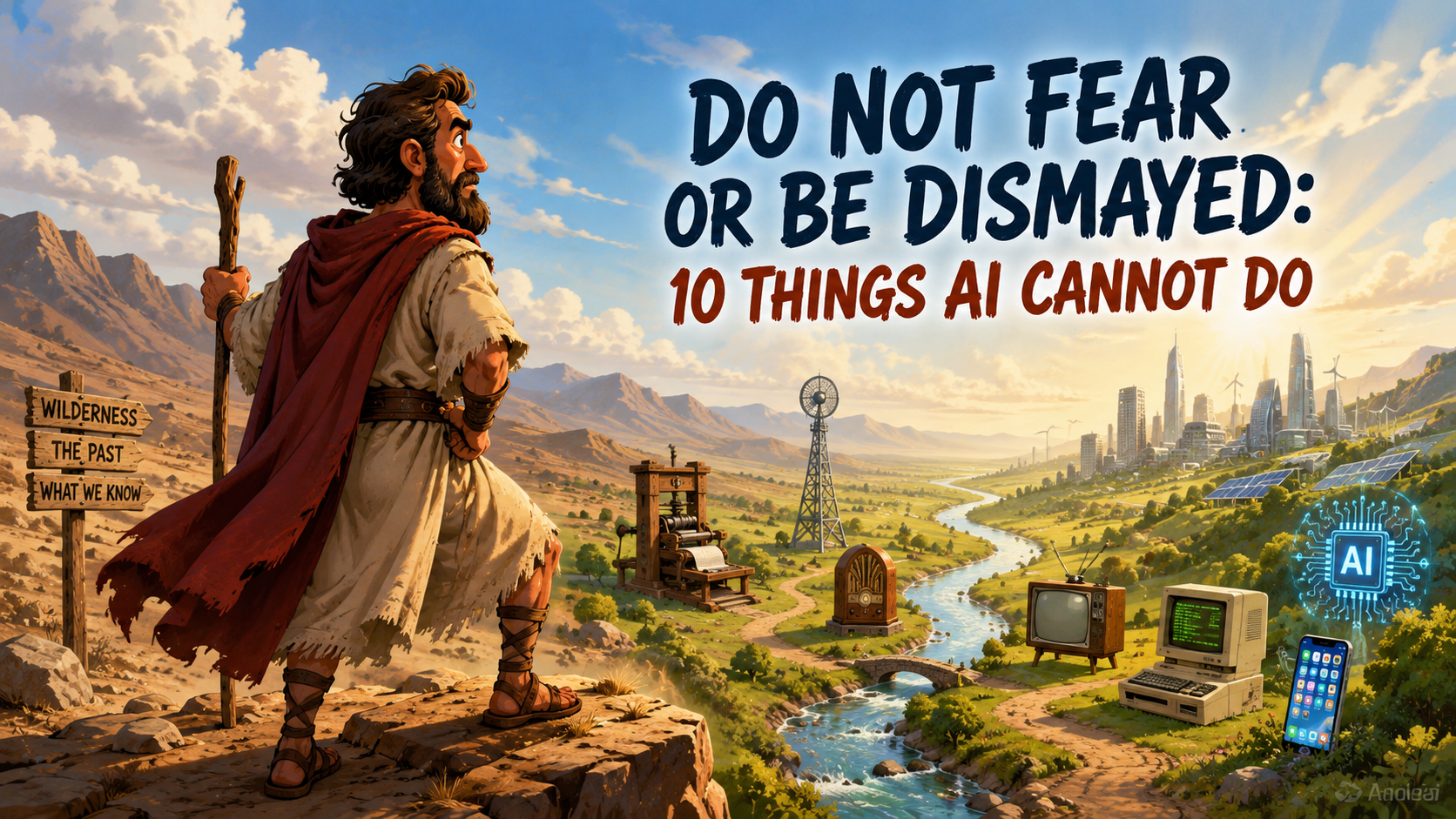
Radical change is always both frightening and exciting. Most have achieved a certain comfort level with the past and all its inventions, even though those very same inventions, like the wheel, the printing press, radio, television, computers and the internet, each in their turn cast previous generations into the same tizzy we are witnessing today over emerging AI. To the comfortable, change is scary. “Who can guess where this will all lead?”
Jason Pargin, author of John Dies in the End, who has often written under the pen name, David Wong, noted in a discussion over the anticipations of over a century of Sci-fi movies and books that while many sci-fi visionists have been able to predict what inventions the future would hold for us, they rarely have enough foresight to understand the kinds of worlds that these inventions will build… or how these inventions will impact the human psyche in community.
What would people do in a world where almost all meaningful work could be done faster and cheaper and better by AI or AI powered machines like Alien’s Ash and Bishop? People are anti-fragile and they need meaningful work to do. Like hatching chicks who often die if someone helps them too much when coming out of the egg, we self-destruct when delivered from stress, pain, and responsibility… free is bad for us… easy is bad for us. (Please apply this to the welfare state)
Insights from Smith
The Matrix’s Agent Smith spoke true when he said, “Did you know that the first Matrix was designed to be a perfect human world where none suffered or everyone would be happy? It was a disaster. No one would accept the program. Entire crops were lost. Some believed that we lacked the programming language to describe your perfect world. But I believe that as a species, human beings define their reality through misery and suffering. So the perfect world was a dream that your primitive cerebrum kept trying to wake up from. Which is why the matrix was redesigned to this, the peak of your civilization. I say your civilization because as soon as we started thinking for you, it really became our civilization, which is of course what this is all about.”
I’m Getting There, Cool Your Jets
I’m sure the conversation thus far is not meeting the needs of the first half of my title, drawn from Joshua 8:1 & 10:25, as Israel leaves the familiar wilderness to embark on a brave new adventure in the Promise Land. But it’s right on course. Change is before them. Far from going to a place where there’s bounty for nothing and your chickens for free, (I hereby officially beg for Mark Knopfler’s forgiveness for that line) they are entering a land inhabited by “giants” and people groups with more technological advance than they have. They will have to fight for every inch of ground against daunting enemies. But they should not fear, for God is with them and for them.
Once Upon a Time in New England
I’ve been witness to several radical inventions in my lifetime. I lived before household computers, saw my first Walkman when I was in 8th grade, got our first microwave in my sophomore year. I was an adult with two kids before I ever saw a windows format. I was doing my first masters when the internet became publicly available, and was finished with my PhD coursework and working on my doctoral dissertation when I got my first cell phone. I was several years finished with that before I got a smart phone.
I still remember the impression that my first exposure to digital photography had on me. We had taken our kids to Sears for family portraits. They put up digitals immediately, so we could pick right away instead of coming back in a week to look them over. It blew my mind. I said to my wife while going home, “That is the future of photography.” If the CEO of Kodak had perceived what I knew instantly, they might still be thriving today. In fact, within a few short years everything in the photographic world turned on its head. The Fotomat booths that once populated almost every store’s parking lot disappeared like so many pay phones, bulldozed, with every trace of them paved over to create one more parking spot.
With every leap forward, it felt the same way as it does now… exciting and scary, and everyone scrambling to protect their own personal interests in the traditional systems and everyone else asking, “How will this technology affect the functioning of the world?”
A Day Late and a Dollar Short?
I often joke that they should write on my tombstone, “A day late and a dollar short.” I always seem to be scrambling to catch up. I emerged into my best years of writing at a time when Millennials and GenZ, for all intents and purposes, stopped reading. I scrambled to learn PowerPoint when the days of chalk and a chalkboard turned almost overnight to whiteboards and projections and then giant flatscreen TVs. When I show up, the party always seems to be just ending, and I have to start all over again learning the next thing, only to have even that rug pulled out from under me by still another thing… the wonder of theaters captured in VHS turned to DVD then Blu-ray and now streaming… (Don’t cry for me, Argentina… or any place else… I’ll be fine.)
On the Train Early
With AI, however, I feel like I’m finally onboard early. I’m watching it evolve rapidly before my eyes and within a year I’ve seen it explode in capabilities beyond my wildest imaginings. A year ago, I was wrestling to get the pictures I wanted without ridiculous spelling errors, warped faces, characters with too many arms and two left feet. A year ago, I worked with AI with only the barest hope of getting a solid demo of the songs I was writing (because musician “friends” refused to help me put them to music). The AI demos were fraught with errors, and I was unable to repair them… surely, I thought, my musician friends will take me more seriously and help me perfect them… Yeah… no. But now… sometimes from one day to the next various programs take giant leaps forward and a whole new set of possibilities blossom in my imagination. I’ve been able to take early flawed versions that still captured the way my heart heard the songs and redo them with astounding results that keep the soul of the originals.
Good for Me but Bad for You?
And that is an important point. While I fear what AI will mean for those growing up with it… fear that, like with overly beautiful people, too much in life will come without effort… I am excited by what it means for someone like me who has long training in artistic imagination, writing, logic, and research… who has languished in the frustration of being unable to gain access to so many artistic talents because of scarcity, cost, and… to be honest… uncooperative personalities. To me, this brave new world feels like hope in the desert… if I can just live long enough to accomplish four decades of bottlenecked desires.
On the Train TOO Early?
Because life is hard, I find myself feeling not like I showed up to the AI party too late, but now… just a bit too early. Some people can’t win for losing. I spent many decades of learning being told I was too young and then suddenly almost overnight I was being told I am too old. I’m not whining, just explaining… I will not be dissuaded in this.
You see, those very same artists who denied me help for so many years… and many like me… have also set themselves against anyone who would use AI to get the help they would not give. I guess we are supposed to allow our own dreams to die unless they deign to permit them.
I get it. They are afraid and feel cheated. They feel that their years of training as musicians and artists should not be sidelined by developing technology that permits “any old clod” to write songs and produce music. So many have said things to me like, “How would you feel if someone came along and wrote a book using AI?”
What’s Good for the Goose
They’ve got me there. Because I confess that I often feel the same frustration in reverse. Many Christian musicians seem to believe that years spent mastering an instrument automatically qualifies them to write the worship and theology those instruments will carry. Yet if producing the musical part of Christian music demands training, discipline, and expertise, surely the same is true of the Christian part. Moral fortitude… a soul that worships… genuine gospel testimony… and should not our songs have rich biblical understanding and meaningful theological reflection plugged into over 2000 years of Christian life and worship?
In my own work, I do not hear music as notes on a staff, but I know the song I am pursuing. I hear its pace, flow, emotional contours, style, instrumentation, and vocal character. AI does not create that vision for me; it allows me to translate what I hear internally into something others can hear externally. And it does this not through musical theft (unless we want to accuse every musician ever of the same theft) but, innovates mathematically doing what artists have always done: recognizing patterns, building upon them, and arranging them in new ways.
Is Good for the Gander
I suspect many of the people most offended by AI-generated music feel toward my musical compositions what I have often felt toward their lyrics. They see an outsider trespassing on their craft. I see talented musicians trespassing on mine. The difference is that I have not spent the last few years arguing that they should be forbidden from trying. I have not attempted to deny them an audience from the get-go. I have always been willing to work with them, but they have indignantly refused to work with me… not because the songs are bad, but because AI touched them at some point in their creation. One even said, “The better they are the more I will hate them.”
10 Things AI Cannot Do… Including Some It Will Never Be Able to Do
So, to ease their fears… even though expressed as if righteous indignation… Here are 10 Things AI cannot do.
1. AI cannot perform live… or allow me to perform live. You are all safe from having to share a stage with me or most other song writers using AI for final song creation. While, it is always my hope that some of you will sing my songs live on stage, the entire concert industry is safe from AI… No screaming fans… No big venues. You can all continue to reap the proceeds from festivals, hot dog, soda, and popcorn sales. Oh! And dentists will remain grateful for the business you inadvertently send their way.
2. AI cannot help you set up for that concert… so Roadies are safe… at least until the androids come.
3. AI cannot help you clean up after that concert… so janitorial staff is safe too.
4. AI cannot build that concert hall… almost all construction-based industry is safe.
5. AI cannot come to your house (perhaps while you are away attending or performing a concert) and fix stuff. It’s can’t patch your roof. Hmmm… but it can tell homeowners how to fix their own stuff so maybe that is not as comforting as I’d hoped. No matter, people will more than likely always need that human touch when the bathtub is dripping onto the flat screen in the living room below.
6. AI cannot, yet, play with a song spontaneously… or even overly creatively… which goes along with live performances, but is distinct. The thing I wanted most when I first began to write these songs and to produce my vision of them with AI was to use them as demos to get live performers so we could together create something yet more spectacular… AH! My rudimentary vision combined with their musical ingenuity and performance skills raising my own efforts to new heights. Lord let it be… send me an unoffended team.
7. AI songs cannot respond to the flow of worship in a room. So many churches have taken to using videos for their worship services. They cannot gather enough live musical talent to float a worship team… or sometimes get a single singer who can play and lead, so they play videos. Now no matter how good those videos are, they do not replace a worship leader or worship team. You can’t stay on a verse or chorus as you please. You cannot spontaneously move to a new and unexpected song or easily revisit songs you’ve already done, or do an on the spot imaginative mash-up.
8. No matter what the Matrix writers fear, AI will always need the ingenuity of human masters… because no matter what Agent Smith, WOPR, Ash, Bishop, Sonny, David, or the Terminator might lead us to imagine, AI remains a tool. An astonishing tool… perhaps the most powerful tool many of us will ever see… but a tool nonetheless. It does not love, worship, pray, hope, regret, forgive, sacrifice, or dream. It feels no joy at a child’s birth, no grief at a parent’s death. It can do evil, but not sin… nor feel guilt for what it is used by sinners to do. It feels no gratitude for grace. It does not stand in awe beneath a star-filled sky or marvel at the cross of Christ. It can imitate the language of these things, but it cannot experience them.
9. AI cannot receive a calling. AI has no vocation, no burden from God, no sense of stewardship, no mission. No hopes for the salvation of man or the preservation of marriage, or family, or society. It cannot be called to preach, teach, shepherd, create, evangelize, or serve. People need people… always.
10. AI cannot bear God’s image. God made man in His image. Christ died for people, not algorithms. The Spirit indwells believers, not software. The church is a community of people, not programs.
AI may change the way we work, create, communicate, and learn. But it cannot bear God’s image, and that means the most important things about humanity remains beyond its reach. That means that like any tool, it needs living agents to shape meaning and experience.
Do not fear or be dismayed. God is with us and God is for us.
~Andrew D. Sargent, PhD
Discover more from Biblical Literacy with Dr. Andrew D. Sargent
Subscribe to get the latest posts sent to your email.