


An Exciting Opportunity
I was recently asked to do a Zoom devotional for a Christian company. I was also asked if they could use one of my songs for the worship time beforehand. I was thrilled. I write songs with several decades of biblical theology and scholarship behind them… and I think they are really good songs… and I wish to offer them to the global church to aid in their worship.
A Grateful Lover
This is not unlike the way we all appreciate a good love song when it puts our own struggling feelings for our significant other (or would-be significant other as the case may be) into an artful and moving performance. When I was a kid, we’d call into radio stations to “dedicate” one of these lovelies to our best girl or guy… We’d spend hours listening to the radio for all the right songs to record as a mix tape for the same. Oh! the dedication… surely this will win our love’s heart, we thought.
A GOOD CHOICE I THOUGHT
Since I was going to do a devotional on Psalm 8, I offered up my song “How Can It Be,” which I wrote as a mash-up-response of worship to Psalm 8 and Psalm 19, which share connected themes. I spent a lot of time writing that one. I agonized over every word. I belabored every pause, every beat change. I knew exactly how I wanted it to be sung and could virtually hear it in my head before I did that terrible thing that causes so much apoplexy among Christian musicians…
I offered the song on the altar of Satan that it might be used as a tool of the Devil to deceive Christians and lure them away from the true faith.
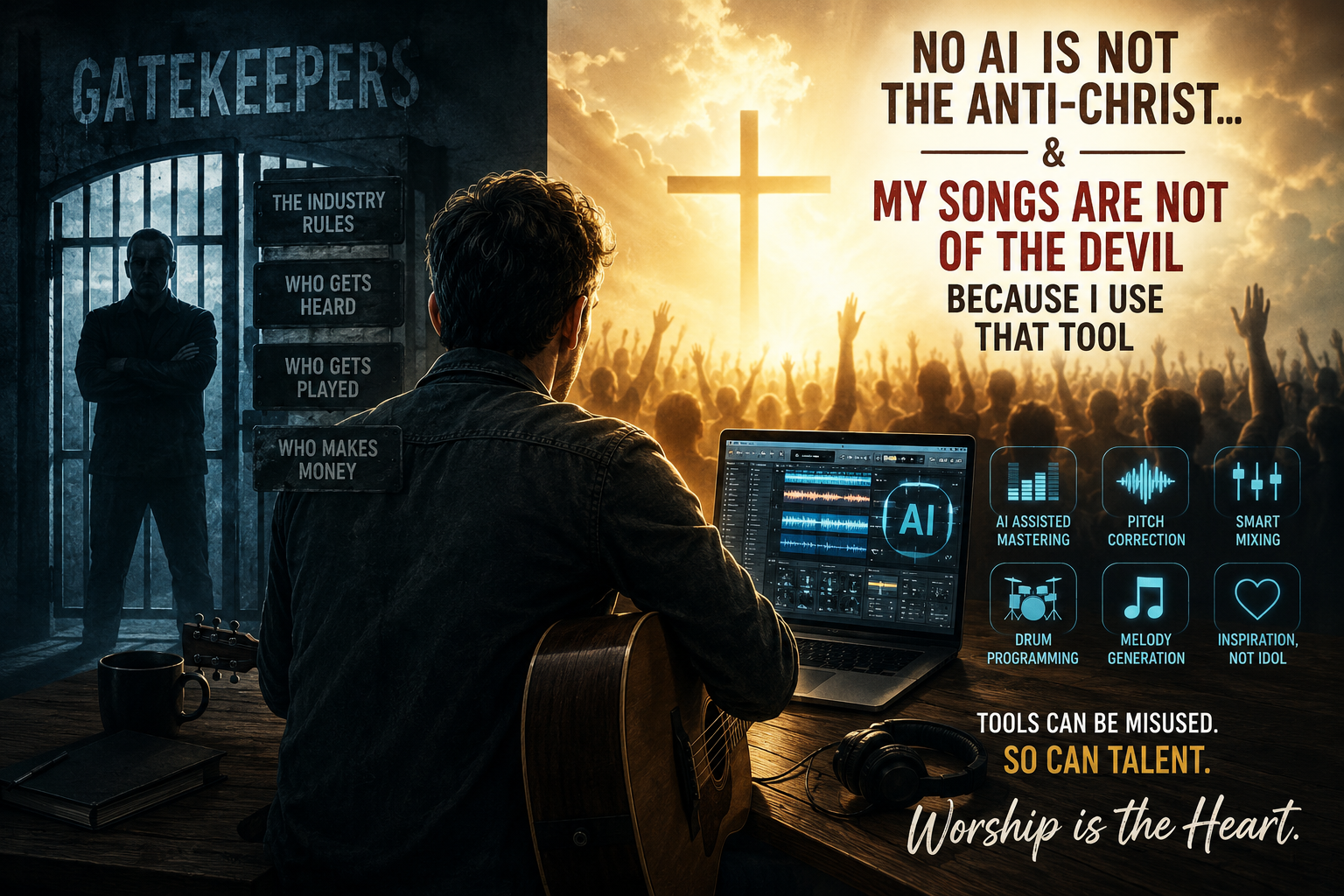
Ha! Just kidding… I simply used the tools available to me to produce MY SONG with the music I ENVISIONED… I used AI to make a release-ready version of my song. Oh! the shame. How dare I?!
A SAD BUT TYPICAL RESPONSE
The music leader for this event seemed to suspect something about my song[1] (Something I never hide… so kudos on his investigative skills). He ran it through a computer analysis or something and discovered the horrid truth of it… It was AI produced. Not AI written, which is an important distinction to me… just AI produced. It was anathema!!! The horror. The terror. The great deceiver of man had come in a really good worship song (If I’m allowed to say that about my own baby). Minds will be deluded. Lines will be crossed that can’t be uncrossed. Alas! Shut the door and keep out the Devil! Shut the door, keep the Devil in the night… to quote from (in proper spelling) “Shut De Do,” a popular Christian song by Randy Stonehill on his 1976 Welcome to Paradise album… on which Stonehill… naturally… did NOT use AI. That worship leader did shut the door, however, and refused to play my song.
I am not angry about that, though a tad disappointed. I have another purpose altogether in telling the story.
And here it is. This is such a common response from Christian musicians who claim to want to promote good songs of worship for the church that you’d think I HAD offered it up to Satan and then tried to trick Christians into singing my song… luring them away from the faith one perfectly performed note at a time in a song that only SEEMED to be an act of worship from my soul to the Creator of All.
AN UNCOMFORTABLE TRUTH
Let’s be honest. The Christian music industry is largely controlled by unbelievers. Today, most major Contemporary Christian Music labels are owned outright or distributed through the same multinational corporations that dominate the secular music industry. Capitol Christian Music Group is owned by Universal Music Group, Provident Entertainment is owned by Sony Music Entertainment, and many other “independent” Christian labels rely heavily on secular corporate distribution systems for marketing, streaming placement, radio promotion, and retail access. As a result, much of modern CCM now functions inside entertainment structures driven primarily by profitability, branding, celebrity culture, and market expansion rather than theological depth, discipleship, or church accountability.
SAD INDUSTRY STANDARDS
In this machine, the most popular performers are far too often compromised morally, and ethically, and struggling with dark and destructive penchants.[2] Their music reveals them to be even more often theologically infantile and biblically illiterate.[3]
In the industry, these performers are not people to be discipled but rather money machines that need to be well-oiled so they can be used by those whose interests in them go no further than profits. Use them until they’re used up and then cast them away. How many are the casualties on all sides of this machine? Only God can count.
It is an industry in which one must play-the-game, pay the piper, bend the knee, kiss the ring, sell their soul, dance with the devil, and drink the poison… telling themselves all the while that they will heal later from that poison once they’ve finally “made it.”
A FAIR WARNING
[Tip: When you compromise everything good about yourself to “make it,” (which is not your artistic skills by the way, but devotion and integrity before the Lord) your usefulness for the kingdom thereafter is significantly damaged by that compromise. You don’t get to pretend compromise until you “make it”… it is actual, and integrity is a hard thing to win back after years of soul defilement and misguided priorities. P.S. A willingness to compromise the best parts of your heart to “make it” is itself a red flag. Guard your heart.]
A COMMON SELF-MISCONCEPTION
In this industry those who do “make it” are usually convinced that it is because they are superior to other performers… better than those wannabes who couldn’t cut the mustard… couldn’t hack it… didn’t have the chops… couldn’t run with the big dogs.
And they may not be too far off in some senses, because many of those wannabees (outstanding singers, song writers, musicians, and performers with much to offer the Church if they can get past the industry gatekeepers) didn’t know how to grease the wheels, refused to swim with the sharks, weren’t willing to step on necks or crawl over corpses. They are often people who didn’t or don’t have the stomach for it. Many don’t know which backs to scratch, aren’t willing to drink the Kool-Aid, don’t know how to work the angles or navigate the wolves… lack that killer instinct. Still others simply couldn’t raise the funds, or make the contacts, impress the right people at the right time, or master the methods of self-advancement.
ANOTHER UNCOMFORTABLE TRUTH
You do know that being a good artist is a radically different matter than being good at self-promotion. It’s not only the cream that rises, but also bodies filled with gases of decay. (Sorry, that was gross and overly dramatic.)
A WAY FORWARD
So anyway… let us all dispense with the illusion that the Christian music industry is about talent and having a heart for worship, even though some successful artists have both.
And let’s get past the jealous reaction[4] to “protect the art” from the encroachments of AI produced songs.[5] Yes, it’s production speed and quality and innovation in the hands of the worshipful masses is a serious competitor to those who have functioned as gatekeepers in the Christian music industry, but AI is NOT the anti-Christ… and my songs are NOT of the Devil because I use that tool.
I call all Christian musicians to focus most on the joy of having good songs to sing. Ask these questions before all others. “Is this song good? Is this song truth? Does this song honor Christ, disciple the church, advance the gospel, spur on a heart of worship?”
Thus, I call on all Christian musicians to forsake their self-identification as uniquely gifted artistic elites whose value depends on keeping ordinary people locked outside the gates of meaningful creative expression in the church, on the radio, on so many music platforms.
Let us worship together and glean the fields white unto harvest with songs worth singing, good songs written and produced by any means by souls with true hearts of worship.
~Andrew D. Sargent, PhD
[1] I like to tell myself that the song was just too good… and a man’s song sung by a female voice… but maybe it was something else.
[2] My Teens involved constant attendance to Christian artists. Phil Driscoll, Amy Grant, Andraé Crouch, Michael English, Sandi Patty, Larry Norman, Randy Stonehill, Don Francisco, B. J. Thomas, & even the Christian albums of Bob Dylan… to name a few. I was a big fan of Mike Warnke, as well…Over time, the sheer number of affairs, divorces, addictions, fake testimonies, and actual crimes from them shook me deeply. More than a few friends walked away from their faith with Christian artist’s names on their lips. Today we are witnessing grotesque acts of immorality & public “deconstructions” as many Christian artists use their fame to intentionally sabotage the faith of their fans, while others with weak theology, emotional self-obsession & an openness to Critical Marxist ideas spread subtle spiritual poison.
[3] There are, of course, some wonderful songs being produced each year that do have rich theology and solid Bible… “So Will I” stands out to me of late. Solid Biblical Theology there… but there is a definite tendency toward shallow thinking and merely emotionalized, self-focused “worship.”
[4] Envy is anger and covetousness over what someone else has. Jealousy is anger caused by feeling that something you have is endangered and threatened by someone else.
[5] If you refuse, you owe every drummer a grand apology for using drum machines. And while you’re at it, apologize to every orchestra displaced by synthesizers, every background singer replaced by vocal processing, every studio musician replaced by sampling, every imperfect vocalist who couldn’t afford to be corrected by Auto-Tune, and every analog engineer replaced by digital production suites filled with AI-assisted mastering, timing correction, pitch correction, loop generation, and algorithmic mixing tools. The music industry embraced machine assistance decades ago. The outrage only began once ordinary people suddenly gained the power to compete.
Discover more from Biblical Literacy with Dr. Andrew D. Sargent
Subscribe to get the latest posts sent to your email.