

A Murder at the End of the World
I came across an interesting discussion about the role of AI in the life of an artist.[1] I’ll give a transcript:
Speaker: “I’ve worked in Hollywood for a decade. I’ve written stuff from scratch. I’ve adapted books. I’ve always worked alone. But my latest script was a collaboration with the new kid on the block…”
He then announces that he is talking about an AI program that runs the billionaire’s personal hotel they are meeting in. His name is RAY. The room is abuzz.
Speaker: “I know what you’re thinking. A computer… an algorithm can’t make art.”
Woman: “It can, but… not good art… not art from the soul… not the kind of art we need.”
Speaker: “But RAY isn’t an artist. Ray is a tool artists can use. I’m the soul.”
A Tool that Artists Can Use… I’m the soul
This is quite a statement. One I agree with. I’m not saying that I agree with everything that this speaker will do with AI RAY in light of that conviction, but that statement is quite powerful.
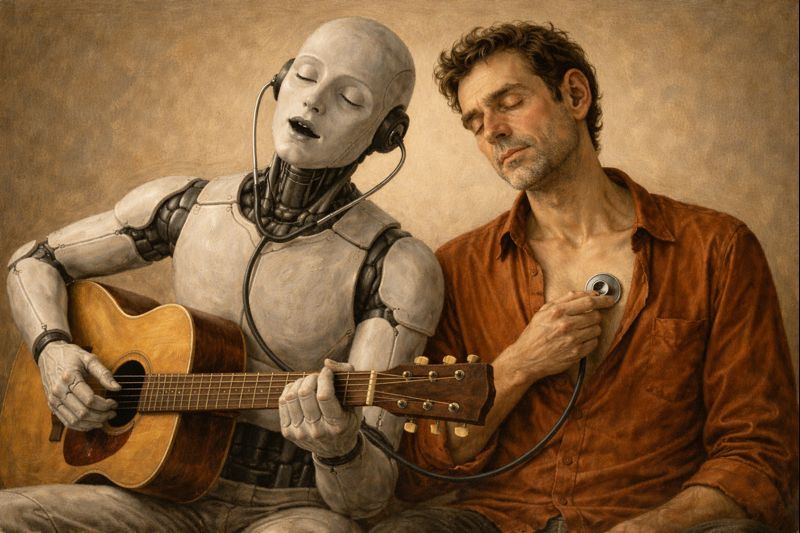
I feel this way, because after several decades of desiring to be a song writer but being unable to play instruments or sing well enough for people to want to hear me on a stage—Bob Dylan be darned—I have finally found an outlet for my own artistic soul. I write songs. I envision the music. I use multiple AI programs to help me approximate that vision in song production. I view these songs as demos, hoping to attract live performers and increase my collaborators, but I will not wait for artists any longer. If they come along, great! If they don’t, I’m going to keep writing, imagining, and producing. I hope the public will like them and stream them and learn to play them.
Let’s unpack the issue a little and see where it takes us.
Claim: “AI can’t be an artist because it lacks soul.”
This argument rests on four intertwined ideas. (a) Consciousness: Art is assumed to require a subject who feels something. (b) Intention: Art isn’t just output — it’s someone wanting to say something. (c) Value across time: The work must be expressive enough to resonate with others who share no context. (d) Accountability: Someone must be answerable for the meaning: “Who said this?” and “Why?”
On that basis, AI is ruled out because it has no private inner life, no commitments, no mortality, no pain, no longing, no death, no stakes.
Art is in the Eye of the Beholder?
The biggest question I’m asked about my songs is, “Who is that singing? Is it you?” People are always a little disappointed when I say (and never hide the fact that) it is a computer simulation of a singer. It is unsettling because we are not accustomed to having no artist to praise for the performance. They love the songs until they have no one to “worship” for the show.
Claim: “I am the soul; AI is a tool.”
This counter-claim reframes the whole problem. The output isn’t valuable because the machine has a soul, but because the human has a soul and uses the machine. It shifts artistic agency to who chooses, who imagines, who guides, who rejects or embraces, who suffers or rejoices, who means something in the creation process.
But That’s What ALL Artists Do
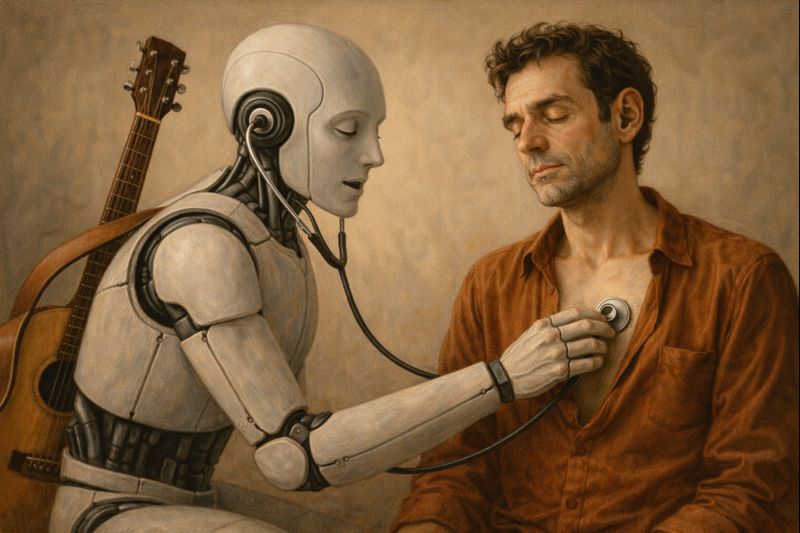
When talking about AI it is more than how we already talk about brushes, pianos, or even drum machines, or editing tools like DaVinci Resolve, or Descript… both of which I use extensively. Its more like a camera that captures or fails to capture what an artist hopes to capture when they snap the photo. It’s like a 3-D printer making something that someone else thinks up. But more so. It’s like a person with perfect recall, imitative skills who learns and innovates and has the ability to take next steps… like artists do. For, every artist recalls, imitates, and innovates with the ability to envision next steps. All artists stand on the shoulders of greatness and reach a little higher. Our minds themselves extrapolate from foundational observations and dependencies on creation itself in exactly the same way.
AI produces… but production does not equal authorship. Authorship requires originating intention, ownership of meaning, bearing of risk, and standing behind the work. AI does not, at present, possess these abilities, whatever we may fear for the future.
So the strongest version of the claim is that AI expands the surface area of human authorship without relocating the soul of art.
The Artist’s Frontier
The real frontier isn’t the fear that AI replaces art, but rather the question, “Can human beings learn to occupy new artistic roles where curation, direction, and selection become central, pushing artists more firmly toward being composers of meaning and architects of intention, rather than merely manual laborers of any given medium?”
A Cripple Needs a Wheelchair
A mute mouth can still be attached to a singing heart. A handless arm can still be attached to an artist with a yearning desire to capture and tell, to discern and reveal.
I can’t play or sing, but I have a lyric heart and I can write. I don’t have formal music theory training beyond what I got in grade school with our ex-hippie music teacher, but I can hear the music in my head, can respond in my heart, and can tell a musician, “That’s not quite it,” “a little faster,” “pause here just a little more,” “run those words together as if they are exploding out,” “Put the emphasis here and not there.”
Things Never Change
This is already how modern filmmaking works. Directors don’t paint frames; they orchestrate teams and technologies. This is already how modern music production works. Producers don’t play every note; they cast a vision for sonic worlds that performers populate.
The Soul of the “Soul” Line
The “soul” line in that show resonates because it returns to the one thing AI genuinely cannot fake… i.e. the experience of being a finite, suffering, meaning-hungry creature. Humans make art because we die, we love, we regret, we yearn, we believe, we fear, we hope, and we both appreciate beauty and crave meaning… and, behind it all, we have a passionate desire to communicate all these things, to be seen, known, understood.
No matter how good AI becomes at imitating the expression of those things, it cannot acquire the existential nature that makes those things true in the first place.
So yes, AI has no soul — but artists do — and the soul sits with the one who intends.
Here I Stand
So, after several decades of being refused by those with the necessary practical musical skills… those too preoccupied with their “stuff” to help me make my heart’s yearning experiential for others, I have finally found a tool that allows me to bring my yearning for expression into being.
Many of those who have spent their lives denying people like me any real help in doing that are furious and fearful and disdainful that we have chosen to use AI for our musical expression.
I interpret this reaction thus: “We will not help you express yourself musically… but we also wish to deny you any OTHER path to expressing yourself musically.” (Gatekeeper much?) “If you can’t sing and can’t play something then that thing inside you howling to get out into the real world must die so that we can maintain our special status as artists. Only we deserve to be heard.”
I’m done waiting. Here I stand. I can do no other.
~Andrew D. Sargent, PhD
[1] A Murder at the End of the World, Episode 2: “The Silver Doe.”
Discover more from Biblical Literacy with Dr. Andrew D. Sargent
Subscribe to get the latest posts sent to your email.
I could not disagree more. I feel if you did not make the instruments and the amplifiers, you should not call yourself a musician. The same is true in art if you did not create the paint yourself you aren’t creative enough to be called an artist. The only true form of art is sarcasm, of which I am affluent.
This is a point I exploit in my latest article.
The line about “I am the soul; AI is a tool” gets at the heart of the debate for me. Your framing around agency, intention, and accountability is much more useful than the usual all-good or all-bad takes on AI music.
Beautiful reflection on AI music creation and the human soul. One observation: the creative act has shifted from execution to articulation. Models that accept 4.5K token prompts let creators describe their vision in rich detail — mood, structure, style — making the prompt itself a form of artistic expression.
Truly thoughtful perspective. I appreciate the shift away from the usual “AI versus musicians” debate and toward the more practical question of how these tools can support creative experimentation.
The best results still seem to require human input: deciding on the overall mood, refining the structure, and determining what truly makes sense artistically. I’ve been experimenting with MusicGPT in this regard, and it’s been useful for quickly testing musical ideas before committing to full-scale production. While the technology can speed up the creative process, the final creative decisions remain in the hands of the user.
I appreciated the distinction here between producing a polished artifact and communicating something rooted in lived experience. AI music feels most interesting when it helps a person explore an idea they already care about, rather than pretending the tool has its own interior life. In my own comparisons of text-to-song systems such as Nafy (https://nafy.ai), the prompt becomes less like a command and more like an editorial brief; the meaningful work is still deciding what deserves to remain.
This is a refreshing way to look at AI in music. Instead of framing the discussion as technology replacing musicians, it makes more sense to focus on how these tools can expand the creative process.
Human judgment still plays the central role. Choosing the right atmosphere, shaping the composition, and deciding whether an idea actually works musically all depend on the creator. I’ve been using GeminiMusic to explore this workflow, especially for testing different musical directions before spending more time on full production. It can make experimentation much faster, but the artistic choices and final direction still come from the person using it.