

All Hail Creative Cheaters
T. S. Elliott famously wrote, “Immature poets imitate; mature poets steal; bad poets deface what they take, and good poets make it into something better, or at least something different.”[1]
This has come into popular vernacular as “Good artists copy; great artists steal,” sometimes attested as a quote from Picasso, but attributed to others as well, all of which would also have been stolen with variations known as far back as W. H. Davenport Adams in 1892, “Great Poets imitate and improve, whereas small ones steal and spoil.”[2]
My Musical Frustrations
Lacking a strong ability to sing consistently enough to garner the admiration of audiences bigger than my once upon a time four small children…
Being unable to play an instrument because I spent my years in academic pursuits in becoming a minister rather than pursuing my other artistic interests like comedy, painting, drawing, and music…
failing to convince many who could… and can… play and sing on a professional level to let me write songs with them… or to put song’s I’ve written to music…
I turned to using AI to give voice to my heart in the creation of demos for songs I have written myself and cast in a musical vision.
I have had hopes that these demos would convince those looking for good material to work with me to put my songs into the markets with a fully human performance. This has been slow going. After an eager start, I realized that I would need to earn funds to hire said performers. Promises of profit sharing has not had the motivational appeal that I have wished.
Looking for Partners in All the Wrong Places
Now as I’ve grown in my efforts… I think I’m getting better at it… learning many things about the details that I’d never imagined needed consideration… I have felt the need to defend myself against certain accusations that musicians and singers are quick to rally against anyone like me daring to play in their sandbox. I’ve been accused of “cheating” and using AI to “steal.” That these systems are not theft in any normal use of the word seems not to matter to those who feel threatened by what AI can do for people like me.
AI, A Thief?
I’ve mulled over these accusations and thought to myself, So you won’t help me… won’t work with me… won’t even look at my songs… won’t let me write with you… but you condemn me for seeking out help where I can find it? That hardly seems fair.
As for the accusation that AI steals… repeated so often by those who don’t actually use it that it has become standard reply by those dismissing my efforts as a song writer… all I can say in the spirit of Adams and Elliott, is that if AI steals, then all musicians are thieves.
AI uses intuitive algorithms to analyze what’s been done, how it is done, learning from others, and spitting out something fresh through innovation, but not copying. And that is nothing more than what almost every modern musician does.[3]
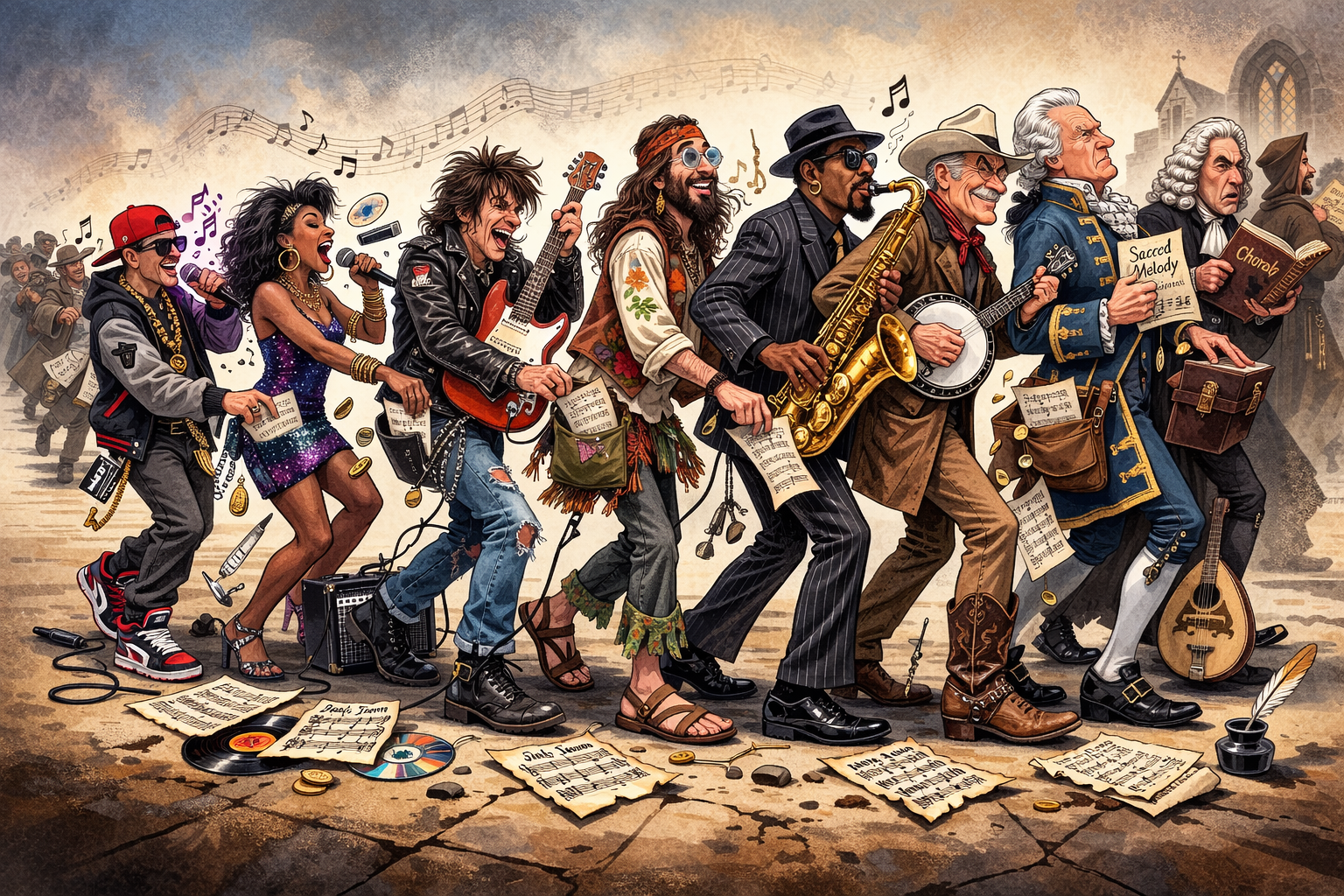
A Long Line of Musical Theives
Rock, for instance, did not spring from nowhere; it absorbed rhythm and blues, which drew from blues, which grew out of spirituals, work songs, ragtime, and brass band traditions. Jazz itself fused West African rhythmic consciousness with European harmonic systems. Blues reshaped field hollers and sacred lament into personal narrative form.[4] Even European classical music—often treated as “pure”—was built from chant, dance forms, folk melodies, and cross-cultural borrowings.
A Longer Line of Musical Theives
Every generation receives a musical heritage, reacts against some of it, intensifies other parts, and carries it forward in altered form. The chain does not stop in the twentieth century—it stretches through Renaissance polyphony to medieval chant,[5] through chant to synagogue and early Christian psalmody,[6] through those to Hebrew liturgical patterns[7] and Greco-Roman modal systems,[8] and behind them to the ancient human impulse to chant, drum, and sing.[9]
However far back we trace it, music is never born in isolation. Only the first dude to whack something with a stick or bang two rocks together has any legitimate claim to authentic creation in terms of music. Even earliest people likely did little more than imitate the sounds of nature around them… that cave mouth howling in the wind, that creaking tree with rustling leaves, that bird song and cacophony of migrating beasts lowing as they went.
The Way of Things
Every musician learns within a tradition, responds to it—sometimes in rebellion, sometimes in reverence—and in doing so becomes both heir and innovator at once.
AI music creation enters this same historical pattern, though with unsettling scale and speed.
AI Can Do Anything You Can do… Or Can It?
AI may or may not be able to replace human ingenuity in responding to musical heritage, but people like me don’t need it to.
AI has no biography. It does not live in a neighborhood, attend a church, feel exclusion, experience revival, or long for transcendence. It has no stake in the music it generates. Historically, genres crystallize not merely from sound experiments but from shared pressure — social tension, worship context, political friction, generational and cultural identity. That kind of pressure produces necessity. AI does not feel necessity.
I can hardly imagine an AI program feeding off of these kinds of social contexts that are perhaps necessary for this kind of innovation, but it can still instantly experiment with combinations that humans might never think of making… simply by having a human soul prodding it from behind, adding his or her soul into the mix through imagination and prompt. AI does not operate in isolation. It is not a self-originating creative agent; it is a responsive instrument in the hands of a necessity-driven human… like me.
AI Steals No More Than Any Other Musician… just faster
Human composers absorb styles slowly—through listening, imitation, practice, and internalization—until influence becomes voice. AI systems likewise learn by detecting patterns across vast bodies of existing music: harmony, rhythm, timbre, structure, production norms.
In that sense, AI systems participate in the same fundamental process that has always governed artistic development—no music emerges ex nihilo; it emerges from patterned inheritance.
AI Innovates
The moral question turns not on influence itself (since influence is universal), but on proximity and attribution: i.e. Does an AI system replicate or innovate? According to those designing these systems for the markets, they innovate… but do so faster and with a much wider musical exposure than even the best human musicians.
Throughout history, innovation has meant metabolizing tradition into something newly coherent; when AI generates music that synthesizes rather than replicates, it mirrors that long arc of cultural transmission.
The controversy arises because AI compresses centuries of apprenticeship and experimentation into milliseconds, making visible—and commercially scalable—the borrowing that has always been embedded in musical evolution.
Most Christian Musicians Stole Shamelessly
The entire history of Christian hymnody was built on even greater levels of “theft.”
“What Child is this?” It uses The secular 16th century English folk song we call Greensleeves.
“Joy to the World?” was adapted by Lowell Mason in 1839 from themes in Handel’s Messiah from 1741.
“Come Thou Fount of Blessing” is sung to the American folk tune “Nettleton.” “The Doxology” uses a tune from the 1500s that was the basis for singing many of the psalms in congregational worship.
The great ones, “Amazing Grace”[10] and “A Mighty Fortress is Our God” [11] are both sung to popular folk tunes from their places of origin. “O’ Sacred Head, Now Wounded” uses an old love song later harmonized by J.S. Bach for sacred songs. Many hymns used the music for “God Save the King.”
The Salvation Army did a musical cut-and-paste with popular bar tunes and music hall performances.[12] “The Lily of the Valley” (Salvation Army hymn) was arranged to the tune of the secular song “The Little Old Log Cabin in the Lane” (arranged by Ira D. Sankey), showing direct reuse of popular melody within a sacred context.
And let’s not forget that Saint Weird Al Yankovic has made an entire career stealing music and twisting lyrics into new shapes.
Get Over Yourselves, and Just Sing, Will You?!
So, my point?
It is for those whose hearts cannot get beyond the fear of AI music creation whether for either jealousy’s[13] sake, or the need to focus not on good songs, but on specific people to admire in their performance.
It is this. The church needs good songs to sing. People like me have hearts to provide them. We may lack certain technical skills in performance, but we are not less worshipful in our offerings for that lack.
Now, we can either accept these offerings and enjoy them when they are worthy of being enjoyed, or we can be held forever prisoner to the far narrower song writing inclinations of those with performance skills… who also “steal” everything they innovate in exactly the same way as I do using the instrumental and singing capabilities of AI.
~Andrew D. Sargent, PhD
[1] T. S. Eliot, “Philip Massinger,” in The Sacred Wood: Essays on Poetry and Criticism (1920).
[2] “Do ‘Great Artists Steal’” (https://bookriot.com/do-great-artists-steal/.) (02/27/2026).
[3] Richard Taruskin, The Oxford History of Western Music (6 vols., 2005). Taruskin repeatedly emphasizes that musical development is evolutionary, not revolutionary.
[4] Amiri Baraka (LeRoi Jones), Blues People (1963); Ted Gioia, The History of Jazz (Oxford University Press, 2011).
Gioia, provides documented lineage from African rhythmic traditions to jazz to rock.
[5] Gustave Reese, Music in the Renaissance, (New York: W. W. Norton, 1954); Harold S. Powers, “Mode” in
The New Grove Dictionary of Music and Musicians (Second Edition, 2001).
[6] Eric Werner, The Sacred Bridge: The Interdependence of Liturgy and Music in Synagogue and Church During the First Millennium, (New York: Columbia University Press, 1959); James McKinnon, The Temple, The Church Fathers, and Early Western Chant, (Aldershot: Ashgate, 1998).
[7] Paul Bradshaw, The Search for the Origins of Christian Worship, (Oxford University Press, 2002).
[8] Thomas J. Mathiesen, Apollo’s Lyre: Greek Music and Music Theory in Antiquity and the Middle Ages, (Lincoln: University of Nebraska Press, 1999).
[9] Bruno Nettl, The Study of Ethnomusicology (University of Illinois Press, 2005); John Blacking,
How Musical Is Man? (University of Washington Press, 1973). Both build foundational anthropological argument that music is a universal human behavior.
[10] Written without prescribed music Amazing Grace came to be associated with the tune “New Britain” (1831) composed just over 51 years afterward, and married together shortly thereafter. Stephen A. Marini, Sacred Song in America: Religion, Music, and Public Culture, (Urbana: University of Illinois Press, 2003.).
[11] Fred L. Precht, “The Historical Development of the Lutheran Chorale,” (https://www.cuchicago.edu/contentassets/6d4b67c8b15c4e99a1720649f3336cb8/perspective-16.pdf); Scott Aniol, “Did Luther Use Tunes from Love Songs?” (https://religiousaffections.org/articles/articles-on-culture/did-luther-use-tunes-from-love-songs) (02/27/2026)
[12] “The Story Behind Salvation Army Music” (https://christianhistoryinstitute.org/magazine/article/story-behind-salvation-army-music?) (02/27/2026).
[13] And I do mean jealousy, not envy.
Discover more from Biblical Literacy with Dr. Andrew D. Sargent
Subscribe to get the latest posts sent to your email.